
A Paradise Lost
8/27/2026 | 55m 45sVideo has Closed Captions
A Hawaiian finch sues the State of Hawai‘i to prevent its imminent extinction.
A PARADISE LOST is the enchanting, yet harrowing tale of a Hawaiian finch who sued the State of Hawai‘i to prevent its imminent extinction, the first animal in history to be named lead plaintiff in a federal lawsuit. The film weaves animation and archival footage to visualize the landmark environmental case "Palila v. Hawaii" told by the stuffed Palila bird who sat at the plaintiff's table.
Problems playing video? | Closed Captioning Feedback
Problems playing video? | Closed Captioning Feedback
Funding provided by the Corporation for Public Broadcasting and the National Endowment for the Arts.
A Paradise Lost
8/27/2026 | 55m 45sVideo has Closed Captions
A PARADISE LOST is the enchanting, yet harrowing tale of a Hawaiian finch who sued the State of Hawai‘i to prevent its imminent extinction, the first animal in history to be named lead plaintiff in a federal lawsuit. The film weaves animation and archival footage to visualize the landmark environmental case "Palila v. Hawaii" told by the stuffed Palila bird who sat at the plaintiff's table.
Problems playing video? | Closed Captioning Feedback
Where to Watch Pacific Heartbeat
Pacific Heartbeat is available to stream on pbs.org and the PBS app.
Providing Support for PBS.org
Learn Moreabout PBS online sponsorshipNATIVE: We are all connected.
NATIVE: When the forests disappeared, we lost our homes.
NATIVE: We lost a lot of our cultural practices after colonization.
NATIVE: But now we're trying to get things back.
IWALANI: Through your art form, people will see your humanity.
NATIVE: We will do whatever it takes for the many generations to come.
♪ ♪ (door opening).
(cart rolling).
♪ ♪ ♪ ♪ (Anuenue speaking in Hawaiian) I ka wa mamua, no keia mokupuni.
A ua nalo i keia Aina Momona.
Once upon an island.
This bountiful land.
A paradise was lost.
When the forests disappeared.
We lost our homes.
So we moved higher, and we survived on the slopes of Mauna Kea, far from the reaches of man.
I will tell you how I stood for our kind.
I sued to save my family, my friends, my keiki.
To reclaim our forest, our land, our birthright.
From uninvited guests, hitchhikers, interlopers.
From the whims of weather, beasts and fire.
Once upon an island, I will tell you the tale of how a paradise lost, was finally found.
♪ ♪ ♪ ♪ My name is Anuenue, but you can call me Anu.
I lived 150 years ago.
My home was the most beautiful island.
A jewel in the Pacific.
Before cars, roads, and tourists.
Way back in the days when the forest was thick with mamane flowers and full of birdsong.
(birds singing).
I remember my tree, my forest, my family.
Aunties, cousins, uncles, grandmas, grandpas, keiki.
Life was sweet.
One day, I was up early eating a breakfast of mamane seeds when I saw a man in a hat.
He spied me through a glass, glinting the sun in my direction.
♪ ♪ ♪ ♪ ♪ ♪ ♪ ♪ (waves crashing).
I dreamt of an ocean.
Flying across it in great strides.
Above the clouds.
Beyond the streams.
Beyond the valleys.
I was free.
A hot, dry wind broke me from my spell.
The man held me in his hands and smiled.
I slid back into my rigid form, unable to move or breathe.
Into darkness, coldness.
When the light returned, another man came.
He removed my insides, cleaned me up, and stitched me back together.
Mounting me on a wooden stick.
And so I remain a trophy for a collector.
A symbol of my species.
My grandmother once told me a story.
I am a unique creature of nature.
The end product of thousands of years of evolution.
GRANDMOTHER: In the beginning, we came from darkness.
Our ancestors were caught in a great storm from a faraway land.
Guided by divine force, they discovered an island.
♪ ♪ They made a home.
Made a family.
Here.
Evolving.
Adapting into a new environment.
Our family grew into 56 birds, each with a different bill to eat different foods, so everyone could enjoy the bounty of the island.
But this Paradise would not remain ours forever.
One day, humans arrived in outrigger canoes.
They brought dogs, chickens, and pigs to feed their people.
We moved up the mountain where humans dared not to go.
They called it Wao Akua.
A most sacred place.
One day, more human arrived, this time in large ships.
They brought cows, sheep, and goats to feed their people.
We moved higher up the mountain.
And their animals escaped to our forests.
Eating our trees.
♪ ♪ The humans began hunting them.
Wild sheep, cattle, and goats.
But the animals, too, were trying to survive.
Crowding us out.
Taking our homes.
Now we have nowhere left to go.
♪ ♪ REPORTER: There's only one place in the world you'll find the Palila on the southwestern slope of Mauna Kea.
They are an endangered species.
This is a mouflon sheep.
It also lives on Mauna Kea.
And it feeds on the same thing the Palila does.
The mamane tree.
If the 500-plus mouflon sheep roam unchecked on Mauna Kea, they'll eat the Palila out of house and home, and it will be all over for the little bird.
ANUENUE: Humans went to court and made me a stuffed bird.
Lead plaintiff whom no one thought was absurd.
Star witness for all bird lovers to say Palila V. Hawaii nature having its court day.
For the humans defending Palila's last stand, six scientists managed something quite grand.
They spoke for the trees, as the Lorax once had, for the birds and the bees and the life of the land.
The sheep and goats, they cannot stop breeding.
Stop growing.
Stop trampling.
Stop constantly feeding.
You must get them out.
All the animals out for you see, mamane trees, they cannot speak out.
They will keep on eating till there is nothing left.
What comes of us palila?
(birds chirping).
(birds chirping).
(birds chirping).
POLIAHU: Many years ago, there lived a Rain God who desired a wife.
He prayed.
And a beautiful woman was born from a flower.
Her name was Leimamane.
They happily lived in peace on Mauna Kea.
One day, Leimamane wandered farther up the mountain, gathering seed pods for dinner.
Thunder God spotted the lovely Leimamane and stole her away to his lair.
She dropped seed pods as she was carried off, leaving a trail for her rescue.
Palila bird saw what happened and flew quickly to tell Rain God.
Rain God rushed to Thunder God's lair high atop Mauna Kea, where he found his dear wife tied up.
Rain God attacked with his rain, and Thunder God fought with his thunder.
The land shook, threatening to destroy the human villages below.
To save the humans.
Sky Father threw a lightning bolt to break up his sons' fight.
Leimamane used her body to shield her husband and died saving him.
Earth Mother was so moved by her act of bravery, she transformed Leimamane into a tree.
Then Thunder God, in his anger, cursed Palila.
Forever you are bound to Leimamane.
If she dies, then you too will die.
Rain God felt for the little bird, so he softened Thunder God's curse.
No other animal shall be able to eat these seeds.
From now on, it will taste bitter to all other creatures.
So you will always have enough to eat.
So it became a symbiotic relationship between mamane trees and Palila birds.
♪ ♪ ♪ ♪ ANUENUE: So the hunters said the birds will totally survive.
They were here before and will continue to thrive.
They said we live in balance, as hunting requires.
Goats and sheep eat grass to prevent wildfires.
There's tons of mamane; we'll never run out.
If only a few hundred animals are grazing about, the state said they'd done their best to preserve Mauna Kea for all creatures, birds, and game herds.
At last, the lawyers used up all their words.
A battle between beasts and we native birds.
REPORTER: Mike Sherwood represents the bird and the bird lovers.
If the mouflon sheep aren't removed, what happens?
MIKE: The Palila would become extinct.
JOHN: Well, the difference would simply be like eliminating the golf courses or eliminating any other thing that the state's plowed money into to build up as a, as a recreational, recreational activity.
DOW: Carroll says the palila and the mouflon can coexist.
Federal Judge Samuel King heard this case.
It isn't known when he'll rule.
For Newsroom 9, I'm Elisia Dow.
ANUENUE: And then, after a time, Judge King finally spoke.
"I've heard everything I need from you, fine folk.
The state has caused harm to endangered palila birds.
Legally negligent for maintaining game herds."
He made it a crime to keep them in Palila's habitat.
No more hunting, no more grazing, no more uh dat.
Like a landowner claiming their original title, returned to us natives to stay on the Isle.
So we won the case.
Palila and mamane forests on Mauna Kea were going to be protected by human law.
Judge King ordered the removal of sheep and goats from our critical habitat.
ANUENUE: How did I, a little bird, become the first animal to go to court to save their kind?
♪ ♪ MARJORIE: My father, Alan Ziegler, was a brilliant scientist, eccentric gentleman who led the staff here at the Vertebrate Zoology Division of the Bishop Museum for 15 or 16 years.
And he was also an activist.
He was very concerned about the loss of species and habitat in Hawaii.
He read an article by Rick Warner called "A Forest Dies on Mauna Kea."
RICK: Over 40% of the mamane forest is dead, unable to withstand the abuse of thousands of feral animals.
Modern man will have produced, to his eternal shame and discredit, another biological desert.
MARJORIE: But my dad was so moved by Rick's article, he just felt like he needed to do something.
Smells just like my dad's office.
All the cases with all the birds.
I just, I remember it so well.
MOLLY: So just down here we have all of the mounted Palila specimens.
MIKE: Look at those Palilas.
The Palila that we used in court was not looking down.
I remember that.
♪ ♪ I'm quite confident that this was my client.
♪ ♪ I got a call from Alan Ziegler, he asked me whether I thought that there would was some legal remedy, and I said, well, there might be.
There's this nifty new law called the Endangered Species Act, and Section Nine of the 1973 law prohibits any person from taking a listed endangered species.
MARJORIE: You don't need to clobber a bird with a club or step on it.
If you take away its habitat that it depends on to survive for essential behaviors, feeding, nesting, resting, that's the same as hurting the bird.
MIKE: I arranged a trip to the Big Island with Dr.
Ziegler and the six experts that we had lined up, and we spent two whole days actually driving around in the Palila habitat.
Evident.
You can see where the sheep and the goats were chewing the young trees down to the dirt.
♪ ♪ So the litigation was called, Palila.
And then with the Latin name comma, an endangered species versus the Hawaii Department of Land and Natural Resources, Dr.
Ziegler told me that, you know, we have a stuffed Palila in our collection in the Bishop Museum, and if you want to use it as an exhibit in the trial, and I thought, that's cool, maybe we should bring it into court with us and put it on counsel table, because it is a plaintiff.
The newspapers loved it, there were front-page stories of the bird winging its way into court.
Many of the endemic birds that had evolved in Hawaii had already gone extinct.
And most of the others were endangered.
At least the public was not aware of this horrendous problem of species going extinct.
ANUENUE: Hunting sheep and goats became a popular sport in the 1950s.
It didn't matter that we were living here first.
♪ ♪ MILES: This sheep you see up here, this is a mouflon, almost a pure mouflon sheep.
This one you see on the very top here is the feral sheep.
When I started, it was kind of a pro-hunting environment, you know, at the, you know, they were hunters look forward to hunting on Mauna Kea.
And Mauna Kea had a lot of sheep in excess of 6 or 7,000 sheep, if not more.
There was a definite browse line of six feet under those trees.
All the vegetation was gone.
PAUL: And these trees take at least 25 to 30 years to become of a large enough size that they're useful to Palila.
There are very few alternative foods that they can fall back on.
So as goes the Mamane Forest, goes Palila.
ANUENUE: We Palila can live for 13 years.
Saving a forest can take 50, perhaps 100 years.
Many lifetimes.
MARJORIE: And that's why the Palila case is, is tragic.
Because the state and the hunters place as much value on continental barnyard animals gone wild as they do a bird that has evolved over millions of years.
REPORTER: A massive drop in the population of the endangered Palila bird is being reported by state and federal organizations.
PAUL: After 30 years of counts, unfortunately, the trend is down.
When resources are scarce, Palila is the one to suffer.
The goats and mouflon sheep, as well as the drought, have taken a toll on the mamane forests.
DAVID: In 1979, the court ordered the eradication of sheep and goats from the mountain, and in 1986, it ordered the eradication of Mouflon.
And as we sit here today, there continue to be ungulates on the mountain.
MARJORIE: Palila and its co-plaintiffs have been to court six times.
MIKE: I think now is one of the longest, if not the longest, pending cases in, in American judicial history.
CHRIS: There's been decades of habitat conversion into pastures and pavements, and the grazing has really degraded the habitat.
If you work in Hawaii, you're working on the front lines of extinction every day, and now with global climate change and the raising of the mosquito zone, we're running out of time.
(wind rustling).
ANUENUE: Being a rare bird is dangerous.
40 years later, we were still critically endangered.
(waves crashing).
(chanting in native language).
(chanting in native language).
(chanting in native language).
KALA: I've been working with Palila for two years now.
Hawaii is unique because of the species that exist here and existed here before people were here.
At a very basic level, people know that Hawaii is the Endangered Species Capital of the World.
I decided to go back to school, study Hawaiian studies with a Malama Aina focus.
Hawaiian resource management with a cultural perspective.
You see different areas that Hawaiians could help contribute to natural resource management.
Working with species like Palila and working with species like mamane is a dream, dream come true to be able to work on Mauna Kea.
(indistinct background chatter).
So for the next couple of days, we're hosting what we refer to as the Palila Point Counts.
It's a survey that's done every year in the core population of the Palila.
And we essentially attempt to count the amount of Palila that are on the mountain.
(crickets chirping).
(music playing on radio).
It's 5:09, and we are leaving Mauna Kea Recreation Facility to head to Kaohe on the first day of our 2017 Palila annual survey point counts.
♪ ♪ This would be my third point count.
We pair up a primary counter with a secondary counter.
All of the pairs will get dropped off at certain areas on the mountain.
And depending on where you get dropped off at, you then have to hike to your first transect.
(heavy breathing).
(footsteps).
It's, it's kuleana.
You know, it's kuleana that was given to me the second I was born as a native Hawaiian, right you, you come from the land, and, and you're born into it.
And you need to take care of it as much as you can while you're here so that there's something to hand down to your keiki.
RESEARCHER: How much do we count?
♪ ♪ (indistinct chatter).
♪ ♪ ♪ ♪ ANUENUE: Before, it was all white guys watching us.
Nowadays, young Hawaiians are the ones watching.
(traffic noise).
(traffic noise).
(stampede).
(helicopter whirring).
REPORTER: A protest was held outside the State Department of Land and Natural Resources building on Kilauea and Kauwili in Hilo on Wednesday.
About 20 to 30 hunters demonstrated against the state's policy of eradicating sheep in the Mauna Kea Forest Reserve.
HUNTER: They don't want people to know that there's little lambs up there that are running around getting blasted today.
They're shooting little lambs, pregnant ewes.
It's dirty what they're doing.
KALA: How do you convince somebody that for generations have been coming up to the mountain and harvesting animals and providing for their family for subsistence, how do you convince someone like that to care about a species that is native to the area?
That isn't actually something that you can harvest and eat, that you can go home and feed your family with; it's a hard question to answer.
And, and, and it becomes, it becomes a conflict of, you know, what species has the right to be here, what species has the right to exist?
(nature sounds).
(nature sounds).
♪ ♪ ♪ ♪ ♪ ♪ A lot of the hunters that I've interacted with are old-timers.
And even, some of the hunting community from Waimea, where I'm from, are well-respected.
I don't engage in conflict.
It won't be me trying to convince you that you need to stop hunting on Mauna Kea.
I'll never do that.
(speaking in Hawaiian).
(speaking in Hawaiian).
(speaking in Hawaiian).
KALA: I come from a family of cattle ranchers and hunters.
And for generations, we've, we benefited directly from the food that we were creating.
We were farming.
So that means putting browsing ungulates on vast spaces of land, as well as being able to go into the forest and hunting for an animal that is invasive to our native forest.
Within my immediate family, we have different ideas.
Native species versus non-native species, invasive species.
MIKIALA: Kala is my oldest brother.
He's always been someone I really look up to.
I enjoy the outdoors, fishing, hunting, and my grandpa on both sides.
You know, they hunted; they did the cowboy thing.
And then, one of my close cousins to me, you know, his dad was always hunting, and he kind of got me in the door.
It, you know, I was 7-8 years old, and I was just hooked.
I mean, I loved it.
And then my mom's sister, my Auntie, she used to take us as we were getting older, and she started teaching us how to hunt the right way.
(gunshot).
Oh, you got one, Auntie.
You got one.
Yeah.
You got one!
I see him.
I am a hunter.
I do enjoy hunting.
And it's not just for sport.
It's for, for eating, you know, but at the same time.
I am Hawaiian.
This is my home.
This is my place.
And, you know, I have kids.
At some point in my life, in their life, even if when I have grandkids, I want them to experience, I want the forests to be there, you know, especially like the watersheds taking care of the water, you know, native animals, plants, species, all of that.
You know, it needs to be preserved, you know.
Um, but with the hunting side, it's, it's a lifestyle.
(indistinct conversation).
KALA: One, two, three.
(camera clicks).
♪ ♪ ♪ ♪ ♪ ♪ ANUENUE: Over the next several years, volunteers planted thousands of mamane trees at Puu Mali to build a new home for us on Mauna Kea.
♪ ♪ ♪ ♪ ♪ ♪ Wildfire.
Drought.
Diseases.
Invasive plants and insects.
Death by feral cats.
Mongoose.
Birds of prey.
I thought our kind was doomed.
Yet, faced with uncertain odds, came a new hope.
BRYCE: So this, the Keahou Bird Conservation Center, was built in 1995 and opened the facility specifically for taking care of endangered Hawaiian birds, for the purposes of returning them back to the forest.
It's been over 20 years that Palila has been cared for here.
It's a big decision to have to remove a Palila from its forest home and then to bring it into our Keahou Bird Conservation Center.
We want them to be well taken care of course.
They're paired and mated with a partner that they get along with.
That pair starts to build a nest, in some of the branches and plants that are growing in the aviary.
The female, of course, will lay eggs in the nest.
Palila lay usually has two eggs that are produced per clutch.
And then we have baby Palila.
(birds chirping).
(thunder rumbling).
♪ ♪ KALA: The historic range of Palila occurred around the entirety of Mauna Kea, spanning across the Saddle region all the way up to the slopes of Mauna Loa and even towards Hualalai.
Right now, that population has contracted to just this area here.
There's always been an idea to try and expand the range of Palila.
If there is a fire that sweeps through on this side of the mountain, within the core, then there's a high probability that we could lose a lot of birds or potentially the entire species.
So the idea is to try and expand or create a secondary population on the North Slope of Mauna Kea.
Right now, we're in the heavy planning stages where we're finalizing the actual release plan itself.
Mid-March is when the first cohort of birds will be moved.
♪ ♪ ♪ ♪ ♪ ♪ ANUENUE: We are but mites on the back of an insect.
Incredibly small and part of the greater whole.
♪ ♪ ♪ ♪ ♪ ♪ ♪ ♪ ♪ ♪ ♪ ♪ ♪ ♪ ♪ ♪ ♪ ♪ ♪ ♪ (indistinct conversation).
MAN: That's right, that's right, that's right.
Oh, you can smell it now, getting that from the smell.
CHILD: I can smell it um... (chanting).
NATIVE: Put on that tree, put on that tree, put on that tree.
NATIVE: Yeah.
(chanting).
(chanting continues).
(chanting continues).
(indistinct background chatter).
(indistinct whispering).
♪ ♪ ♪ ♪ (bird chirps).
♪ ♪ (bird chirping).
♪ ♪ ♪ ♪ ♪ ♪ (bird chirping).
(bird chirping).
♪ ♪ ANUENUE: We are here because we came from this island.
Born into it.
And one day, returning to the earth.
♪ ♪ (wind blowing).
ANUENUE: Nature ensures an eventual balance of all life having a chance.
Yet death is a part of the cycle of life.
Ever present.
(birds chirping).
(birds chirping).
TREE: Long ago, when the world was new, lived Wakea Sky Father and Papa Earth Mother.
Mauna Kea was the first born.
What does it mean to ponder her divinity as I, a simple tree who lives on her shoulders?
Mauna Kea is ancient.
She's wild, rugged, and powerful.
Mauna Kea will never die.
But I will die one day, as my wood rots away, feeding the soil, it breathes new life.
Keiki trees are born from seeds brought by bird and human hand.
I am simply a witness to this sliver of the Universe.
♪ ♪ (waves crashing).
KALA: So I guess over time, there was like, like, a lot of different things in Hawaiian culture, and, quote-unquote, Western civilization, a lot of things were separated.
It seemed like there was no room, nor was there validity of ike kupuna.
Or these observations that our kupuna have been noticing and observing for centuries.
But it's, it's really nice to see the scientific community is starting to value that ancestral knowledge.
And really, it's based out of observation, right?
Being able to observe what is happening in your surroundings and seeing what those connections are between yourself and other life forces.
There's a lot of work that needs to be done on Mauna Kea.
But the health of Mauna Kea in its entirety, that I focus on, not just for Palila.
Paila is one small aspect.
Mauna Kea as an entity itself, the species that occur within, my kupuna that come before me, and my keiki that will follow me are okay with the work that I'm doing.
So that's, that's, really when I say kuleana, it's, it's not just responsibility, right?
It's, it's heavy.
♪ ♪ (indistinct background chatter).
Introducing captive birds to the wild is tricky.
Like flying a kite in a storm.
You hope the string doesn't break.
WOMAN: I want one of those shirts I tried... ♪ ♪ KOA: So one of the birds went missing.
We haven't seen it since last Thursday.
And this transmitter was giving a false signal to the weekend crew.
So they went the complete opposite direction.
So we're trying to, like, just expand their search radius, and we're just trying to get a signal anywhere.
Because the whole thing that delayed the initial release was that there wasn't enough food when one of the lead scientists did a phenology survey trying to deduce if that is a cause of death for the birds that have passed away already.
ANUENUE: They never found him.
Of six birds, only two survived.
The pair was caught and returned to the bird center.
I wonder, did they dream of the forest?
♪ ♪ BIRDS: We are the extinct birds.
All 77 of us... KIOEA: We each have our own story.
HAWAIIAN RAIL: Humans would love me more, if they knew my story.
GREATER KOA FINCH: The forgotten are many.
MAMO: Few are famously so.
KAMAO: My extinction doesn't just mean the loss of a bird.
OAHU ALAUAHIO: It's the loss of language, traditions.
ALL BIRDS: It's the silencing of us.
♪ ♪ (birds chirping loudly).
(birds chirping loudly).
ANUENUE: Small islands lose more species to extinction than continents.
A new danger emerged.
Climate change, threatening to finish us off.
♪ ♪ ♪ ♪ (thunder rumbling).
I once had a terrible nightmare.
A great fire blanketed the land and burned for days.
The forests... it was all gone.
Many of our plant and animal friends, they simply disappeared.
(birds chirping).
ANUENUE: In my dream, we survived.
Aloha aina.
The life breath between human, animal, plant and land.
♪ ♪ ♪ ♪ But this, this was only a dream.
♪ ♪ ♪ ♪ ♪ ♪ ♪ ♪ ♪ ♪ ♪ ♪ ♪ ♪ KALA: You haven't seen, you know, mamane being able to branch all the way down to the ground in you know, over 100 years.
The eradication order is still in effect.
A few hundred sheep left on the mountain.
Despite all of our efforts, Palila continues to decline.
We're looking at 300 birds.
We prepare ourselves for what could potentially be the reality.
To me, having a small population of Palila in the wild until they slowly disappear is a much better, mo'olelo than pulling every last one that we can and having them live out the rest of their lives in captivity.
That's, that's not what these species were meant to be.
That's not where they're meant to, to live.
♪ ♪ ANUENUE: Paradise is not a place but found in the journey.
You from the future.
Remember to live.
We carry on through stories.
We live on through you.
This is now your story.
(door closes).
HAUMEA: Once upon an island, I'll tell you the tale.
I'll tell you the tale of how... a paradise lost, was finally found.
♪ ♪ ♪ ♪ (indistinct chatter).
(indistinct chatter).
♪ ♪ (music plays through credits) (waves crashing).
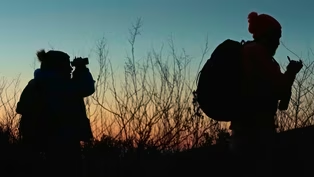
Hawai'i, The Endagered Species Capital of the World
Video has Closed Captions
Kalā and others begin the palila annual survey point counts on Mauna Kea. (2m 44s)
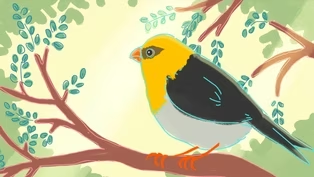
Meet 'Ānuenue, a Palilia Bird Whose Existence is at Risk
Video has Closed Captions
Ānuenue is the name of a palila bird who has been killed; but his story doesn't end there. (2m 7s)
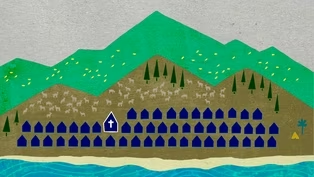
Video has Closed Captions
A Hawaiian finch sues the State of Hawai‘i to prevent its imminent extinction. (30s)
Providing Support for PBS.org
Learn Moreabout PBS online sponsorship











Support for PBS provided by:
Funding provided by the Corporation for Public Broadcasting and the National Endowment for the Arts.