
Signature Dish
Cafe Culture
Season 4 Episode 6 | 29m 8sVideo has Closed Captions
Lost Sock in Takoma, Lemon Slice Cafe in Silver Spring, Rose Ave Bakery in Woodley Park.
In this episode, Seth dives deep into cafe culture. First, he explores the craft of specialty coffee roasting at Lost Sock Roasters in Takoma, delighting in a London Eye Latte. Next, he heads to Silver Spring to visit the Ethiopian-American Lemon Slice Cafe, where he savors the Awaze Tibs Panini. He wraps up in Woodley Park for a sweet treat, indulging in a Pandan Coconut Donut at Rose Ave Bakery.
Problems playing video? | Closed Captioning Feedback
Problems playing video? | Closed Captioning Feedback
Signature Dish is a local public television program presented by WETA
Signature Dish
Cafe Culture
Season 4 Episode 6 | 29m 8sVideo has Closed Captions
In this episode, Seth dives deep into cafe culture. First, he explores the craft of specialty coffee roasting at Lost Sock Roasters in Takoma, delighting in a London Eye Latte. Next, he heads to Silver Spring to visit the Ethiopian-American Lemon Slice Cafe, where he savors the Awaze Tibs Panini. He wraps up in Woodley Park for a sweet treat, indulging in a Pandan Coconut Donut at Rose Ave Bakery.
Problems playing video? | Closed Captioning Feedback
Where to Watch Signature Dish
Signature Dish is available to stream on pbs.org and the PBS app.
Providing Support for PBS.org
Learn Moreabout PBS online sponsorshipANNOUNCER: And now, "Signature Dish," a WETA original series.
SETH: Today on "Signature Dish," we're diving into cafe culture.
We'll first brew up something special.
I'd stand here for another hour and just get this aroma of freshly roasted coffee.
JEFF: Pretty good, right?
SETH: That's amazing.
Then sink our teeth into a savory sensation.
BETHLEHEM: It's like a tough bread, that will soak in all the juice.
SETH: I want to go right back in for another bite.
BETHLEHEM: Let's do it.
SETH: And round things out with a dreamy dessert.
ROSIE: We want this pastry cream to be nice and rich and smooth.
SETH: Lots of words that I like to hear.
I'm Seth Tillman, WETA producer and DC native, and I love good food.
Nice to meet you.
That's why I'm traveling to restaurants across the DMV, at each stop, looking for the one thing you just gotta try... that Signature Dish.
Since you can't talk cafes without talking coffee, I'm kicking things off with a pick-me-up in DC's Takoma neighborhood.
Here, you'll find Lost Sock Roasters, a boutique cafe and small batch coffee roastery, founded by close friends Jeff Yerxa and Nico Cabrera.
NICOLAS: We both went to American University.
We met on our sophomore year in college.
We were really into the food and beverage industry.
JEFF: DC was at a very interesting time where it seemed like there was a lot of energy in the creative sphere of food and beverage.
We'd realized the need for a local coffee roaster.
We were 21 at the time, kinda had nothing to lose.
We were living in a basement apartment, bought a home roaster, started playing around, buying coffee beans online.
NICOLAS: At the beginning, it was tough just because we were college students showing up to these different cafes and people would not really give us the opportunity.
We started doing pop-ups and farmers' markets, and when things really turned was when we opened up this cafe.
It went from a team of like me and Jeff and then maybe two more people, now it's 25 of us.
JEFF: It's been the culmination of almost 10 years of doing business that we've finally been able to supply some of our favorite cafes around the city with our own coffee.
SETH: For Jeff and Nico, traveling to the heart of coffee country is a critical part of the job.
NICOLAS: As someone that was born and raised in Ecuador, I wanted to make something that would allow me to go back to my roots.
JEFF: Being able to go down there and be put up by these farmers, this coffee is their livelihood.
NICOLAS: Our job is to not mess it up, really.
Our job is to brew it and brew it right, and executing at the top level that we can, while also making it a welcoming environment.
JEFF: Lost Sock, the name, everyone asks.
It's what you're looking for in the morning.
Like that lost sock, it's something that you look for.
We hope that's what our coffee is too.
SETH: I'm meeting up with Jeff at Lost Sock's roastery in Northeast DC for our crash course in coffee.
Jeff.
JEFF: Hey.
SETH: Good to meet you.
JEFF: Nice to meet you as well.
Welcome.
SETH: Excited to take my coffee game up to the next level.
What are you guys going to be making today?
JEFF: Yeah, today we're going to be roasting some coffee for our signature drink, the London Eye Latte.
This is a single origin coffee from Turrialba, Costa Rica, and this is raw green coffee.
So what we're looking at here is actually the nut or the seed of a coffee cherry.
Now we're going to start loading up the scale to start our first batch of roasting this.
Whereas wine, grapes ripen on the vine all at the same time.
Coffee ripens, cherry to cherry, at different rates.
So it's extremely labor-intensive.
The pickers have to go through the same exact plant many times during a harvest.
SETH: And we're talking about pretty steep hillsides here too, right?
JEFF: Yeah.
SETH: It's not easy work.
JEFF: Not at all.
It's honestly remarkable that they're able to cultivate the land the way they do.
All right, we got 30 pounds here loaded up, and we're going to bring it over to the roaster and we'll show you how it works.
SETH: Let's get roasting.
JEFF: To get this 30 pounds of this coffee up into the hopper, we're going to use the vacuum.
(vacuum whirring) SETH: Oh, it's going.
JEFF: Yep, little by little.
All right, we're going to load our roast profile.
Roast profile is essentially a recipe.
Each coffee's going to have a different profile.
So we're controlling how hot it's going to get, and also the air volume.
SETH: And so figuring out what works best for every kind of coffee bean, I'm guessing there's just a lot of trial and error involved.
JEFF: When we get a new coffee in, we'll roast it once.
We'll bring it over to the coffee lab, grind it up, cup it.
And then from there, we might make some adjustments, go back to the roaster, roast it again, get to a place that we're confident in the coffee.
Now that we got up to the right temperature, the coffee has dropped into the drum.
And this is what's called the drying phase.
So there's a little bit of moisture content within the green bean.
I'd say in about a minute or two, it's going to start changing to yellow.
Just like toasting a piece of bread, you're changing those chemical compounds into sucrose and different sugars that are going to result in that sweet cup that you're looking for.
So from yellow, you can now start seeing that it's changing into a light brown.
So I'm going to use the trier right here to check in on the roast.
You're able to smell it.
SETH: Oh, yeah, now we're talking coffee.
JEFF: Not quite yet, but you can smell it.
SETH: With the end of the roast cycle now at hand, the beans are dropped into a cooling tray.
Oh, it smells so good right now.
I'd be willing to stand here for another hour, and just get this aroma of freshly roasted coffee.
JEFF: Pretty good, right?
SETH: That's amazing.
What are the notes about this particular coffee that you're looking for?
JEFF: This particular roast is going to be what we consider light to medium roast.
We got a lot of nice nuttiness, some good acidity.
It's just like baker's chocolate.
SETH: After cooling, a destoner does a final sort to separate the beans from any unwanted materials.
And then it's ready for one last ride to the bagging station.
JEFF: So when I turn on the vacuum, the coffee's going to get sucked up and over into the precision fill.
SETH: And I feel like I'm at a drive up bank teller in 1987 here.
The pneumatic air tube, I love it.
JEFF: Yeah.
Old school for sure.
SETH: With the beans on their way, it's time to bag up the coffee.
JEFF: Here we are, the last step.
This here is a precision fill.
We're going to load this up here.
SETH: So this is ready to brew up?
JEFF: Not quite yet.
So during the roasting process, we get a lot of CO2.
And if it's brewed immediately, it mutes a lot of those flavors.
We always let coffee rest at least 24 hours before we taste it.
And so for you, we have the same coffee here that we roasted a few days ago.
SETH: So this is latte ready?
JEFF: This is latte ready.
SETH: All right, I'm going to take this over to Nico.
I'll catch you back at the cafe.
JEFF: I'll see you there.
SETH: Thanks, Jeff.
JEFF: Thank you.
SETH: Nico.
NICOLAS: Seth.
SETH: Good to meet you.
NICOLAS: Good to meet you too.
SETH: All right, I come bearing gifts from the roastery.
NICOLAS: Thank you.
I'm going to add this into the hopper so we can start brewing.
SETH: What is the London Eye Latte all about?
NICOLAS: London Eye Latte is our signature drink here.
It's a play on the London Fog.
We make all of our syrups in house, and we're using Earl Grey tea, vanilla paste, and white sugar.
Now I'm going to pull a shot of espresso.
This machine has a built-in scale that will exactly measure out our shot, 19 grams, making sure that all of our drinks are coming out the same.
Then I'm going to measure our syrup as well.
We don't use pumps here, we measure it by weight.
I'm going to start the espresso machine.
SETH: And what are the different variables that you can control in this machine?
NICOLAS: We can adjust the temperature, but really what we're focusing on is the pressure.
Every morning, we dial in the coffee.
We might be pulling somewhere between 300 to 700 shots a day.
SETH: Wow.
NICOLAS: We're kind of creating a recipe for how the coffee should be tasting that day.
Now I'm going to steam the milk.
We really care about the temperature and the texture of the milk.
It has to be silky smooth.
SETH: And of course, some beautiful art to go on top.
NICOLAS: All right, and this is our London Eye latte.
SETH: That is a thing of beauty.
NICOLAS: Thank you.
SETH: All right, gentlemen.
I loved the peek behind the scenes, how we go from bean all the way to cup.
Cheers.
NICOLAS: Cheers.
JEFF: Cheers.
SETH: Cheers.
That is outstanding.
The syrup is not too sweet.
Beans, perfectly roasted.
I think getting those notes of chocolate from the roast profile, and just the texture is silky, silky smooth.
NICOLAS: Yeah.
That's the point.
The balance of the chocolateiness, the sweetness, and that bergamot note that you get from the Earl Grey in there.
SETH: Wow.
And it looks like we have some snacks to go along with our drinks here.
What are we eating?
NICOLAS: We got some empanadas right here, Argentinian style... SETH: All right, a little dipping sauce?
NICOLAS: ... With a little aji sauce.
It's a sauce we make in house with Peruvian aji peppers.
It's a little cheesy, a little spicy.
And then over here, we have pan de yuca, and this is stuffed with a little bit of guava jelly in it.
SETH: Oooh, all right, so we got a little something savory, a little something sweet.
NICOLAS: Cheers.
SETH: All right.
I like how these Latin American flavors are complimenting this Costa Rican coffee.
And you know, I drink coffee every single day of my life.
But I don't think before today, I really stopped to think about just how much is involved, even before the beans even get to your roaster.
JEFF: Yeah, I think that's a big part of being a barista and working in this industry is being an educator as well.
I feel like most people don't know all the hands it touches before it gets into your cup.
SETH: I like how there's so much science behind it too.
For me, I get to just take a sip and enjoy these great flavors.
JEFF: Yeah, it's something that I love about coffee as well.
It's this perfect marriage of art and science.
We get a new coffee in next week, start over again.
So that's one good thing about coffee is that you're always learning.
SETH: Well, I could start any day of the week with this London Eye Latte.
Thank you both so much.
NICOLAS: Thank you.
JEFF: Thank you for coming.
SETH: I'm headed next to downtown Silver Spring, Maryland.
Just off Colesville Road, in the basement of a commercial office building, sits Lemon Slice Cafe, a hidden gem from Ethiopian-born chef and owner, Beth Yohannes.
BETHLEHEM: My first memory with cooking is my grandmother sitting in the kitchen and me just standing at the door, maybe three or four, watching her.
And everything is like small details.
So I think that just translated into me before even I know it.
I was doing my culinary art school in a city called Bath, and I would go to London to see my brothers.
And of course, I want to eat some Ethiopian food, I'm always craving it.
And I would tell them like, "We can open a restaurant."
I keep imagining it.
So we came up with a plan, and then we opened our first restaurant in London.
It was 1993.
I think that first restaurant, I just loved the interactions with people, cooking and serving, then seeing their face.
It's very addictive.
When I found a spot in downtown Silver Spring, and downtown Silver Spring is where I come to watch people.
So it's just a melting pot.
When I designed the menu, I wanted to be something for everybody.
I also want to include me in it.
And that's why I came up with a comprehensive menu that includes the Ethiopians, and any other person that wants to eat good food.
The feel and the vibe of our cafe is just the way I want it to be.
How are you, my love?
I call everybody my love, and I think we serve a food that's made with love.
It's also for me to meet my neighbors, to feed my neighbors, to hang out with my neighbors.
So I love it.
Have a wonderful day.
PATRON: You too.
SETH: Chef.
BETHLEHEM: Hi, Seth.
SETH: Great to meet you.
BETHLEHEM: Nice to meet you.
SETH: I am so excited about this kind of tucked away cafe.
And it looks like we've got stuff already cooking on the stove here.
What are you making today?
BETHLEHEM: Oh, we're making our signature dish, Awaze Tibs panini sandwich.
So Tibs is a very popular dish in Ethiopia.
It's made from beef or lamb, onion, but we add awaze to it to make it more special.
Awaze is a paste made out of berbere, which is a very staple spice.
So in Ethiopia, awaze tibs, it's usually eaten with injera, but we decided to make it a sandwich here.
SETH: That sounds perfect for a cafe.
And how do you get started on this dish?
BETHLEHEM: So we first start with the ayib, which is an Ethiopian cheese.
Whenever you use a lot of berbere and spice, we pair it with a homemade cheese.
SETH: All right, I have a little bit of a PTSD from making cheese in-house.
Let's go scalding this time.
Oh, God.
That is no joke.
(painful groan) BETHLEHEM: I'm really sorry to hear that, but no hands today.
SETH: All right, that's a relief.
BETHLEHEM: So we'll heat the milk.
We don't boil it, just enough for it to come up hot enough.
SETH: So this is just milk in this pan right here?
BETHLEHEM: This is just milk.
We start, we're going to put some vinegar into our measuring cup, and then you put the milk in the vinegar.
Made a mess.
SETH: That's okay, we can make a mess on "Signature Dish."
BETHLEHEM: Yeah.
So now, it's just going to sit here for two or three minutes until the curd and the whey starts separating.
All right, Seth, it's been a couple of minutes.
You can already see it separating.
SETH: Oh, yeah.
BETHLEHEM: So at this point, I'm going to strain it.
So you can see the whey is really nice and yellow and clear at the bottom.
I use it for something very, very special, and I'll show you later.
SETH: All right, got a little surprise in store today?
BETHLEHEM: Yes, yes.
There is no waste here.
So to make the awaze, we need berbere.
And berbere is made out of minimum 16 ingredients.
And it has black seed, ginger, turmeric, onion, garlic.
I call it a multivitamin because our dishes are centuries old and it comes from, you know, mother, daughter, mother, daughter.
So this is our medicine.
So now, I'm going to make this into a paste.
And I'll put lemon juice, I'll put honey.
SETH: A little sweetness to counteract the spice?
BETHLEHEM: Yeah, to balance, and a little salt.
And then I just thin it out with water.
SETH: And this paste has such a great deep red color too.
BETHLEHEM: Yeah.
So now, we're going to go ahead and make our tibs.
SETH: Some cooking happening, love it.
BETHLEHEM: Yes.
So I'm going to get this pan really hot so that we can get a nice sizzle.
This is seasoned with salt and pepper, onion, and a little oil.
So here we go.
We don't want to overcook it, we just want to make sure that it's nicely seared.
At this point, I'm going to go ahead and add awaze.
(sizzle) SETH: Oh.
And it smelled great when you were mixing it.
BETHLEHEM: Yeah.
And that's it.
SETH: Smells even better when it hits the pan.
BETHLEHEM: Yeah.
And then to finish it, I'll add a little clarified butter.
So this is called kibbeh, and we clarify it and we season it with herb called koseret and corrorima, which is an Ethiopian cardamom.
SETH: All right, I've never heard of flavored clarified butter before.
BETHLEHEM: Yeah.
So that's it.
Our awaze tibs is done.
To make the sandwich, I'll get a ciabatta bread.
I'll layer ayib, which is the Ethiopian cheese we made earlier, and then I will put the awaze tibs on top.
And then we put it on the panini press so that it gets crispy on top, and then juicy in the middle.
And then we plate it with a small side salad with a homemade vinaigrette, and then our awaze tibs panini is ready to enjoy.
SETH: All right, chef.
Can't wait to give it a try.
Let's dig in.
BETHLEHEM: Let's go.
(crunch) SETH: Wow.
That is just crazy good.
BETHLEHEM: Mmm-hmm, thank you.
SETH: That awaze paste gives you that warm, comforting heat, but round it out with some smokiness, some earthy flavors.
BETHLEHEM: Absolutely.
But we chose a ciabatta bread because that will soak in all the juice, and then you can crunch it.
I think it's just the perfect marriage, ciabatta and awaze.
SETH: Almost a little bit intoxicating.
I want to go right back in for another bite.
BETHLEHEM: Let's do it.
(crunch) SETH: And the cheese works so well.
You do pick up a little bit of tang, maybe it's from the lemon juice, that goes really nicely with those warm, smoky and spicy flavors.
BETHLEHEM: Mmm-hmm, but not too spicy.
It's just flavor.
Spicy is a relative word for some people, but I think it's a good balance.
SETH: It's like a warm hug.
BETHLEHEM: Yeah, it's a warm hug, exactly.
SETH: What are we washing it down with here?
BETHLEHEM: This is our famous ginger turmeric lemonade.
So it's made with fresh ginger, fresh turmeric, lemon and water.
SETH: Ooh, nice medicinal, herbal notes in here.
BETHLEHEM: Yes, absolutely.
SETH: Between the berbere and this refreshing tonic, you are a healer as well.
BETHLEHEM: Yep.
Well, whatever we can do on a daily basis.
We're not like health freaks, but good food with some nutrition, I think I'm good with that.
SETH: And one more treat on the table.
BETHLEHEM: Yes, also.
That was the surprise earlier I told you about when I was making cheese.
So we saved the whey, and then we make lemon cake out of it.
And that gives it that moist flavor as well as that tanginess.
SETH: That was a surprise that was well worth the wait.
BETHLEHEM: Thank you.
SETH: The intensity of that lemon flavor comes through so loud and clear.
BETHLEHEM: Yeah.
SETH: I can understand why it's your namesake, because that is easily the best lemon cake I've ever had.
BETHLEHEM: I'm so glad you like it, Seth.
SETH: And I just love, you know, here we are, basement of a office building.
This is just a wonderful little oasis you've created here.
BETHLEHEM: I hope so.
This was my dream.
And I think the fact that you were able to find me and come and enjoy it gives so much joy to my heart.
SETH: Well, I hope a lot more people come and find it.
It is well worth the trip.
Thank you so much, chef.
BETHLEHEM: Thank you, Seth.
I appreciate you with all my heart.
SETH: We did it.
CREW: Alright, that was great.
DIRECTOR: Cut!
SETH: I'm wrapping up my cafe crawl in Woodley Park.
My destination: Rose Ave Bakery, to enjoy a little something sweet.
ROSIE: My parents came as Vietnamese refugees, and they started their business and their lives in Philadelphia.
So I was born and raised there.
And then it wasn't until I graduated college that I moved to DC to start a career at Children's National Medical Center.
I was a pediatric nurse.
At the core of who I am, I felt like I was born to be an artist.
As a nurse, I was always finding ways to be creative, and that became cooking.
Cooking was something that I could create, and also taking it a step further and make it visually beautiful.
That is art.
And I thought this may be something that I may want to pursue as a career.
I applied to be on MasterChef.
I didn't make it, but I had to document my dishes, whether it was savory, whether it was baking, and I would also post it on social media.
SETH: Rosie's Instagram posts caught the eye of DC chef Erik Bruner-Yang, and she soon found herself juggling nursing with a new side gig: pastry chef at Maketto and Toki Underground.
By 2020, she had decided to strike out on her own.
ROSIE: Rose Ave Bakery is the bakery of my dreams.
I wanted to combine all my favorite core memories, the Vietnamese bakeries in South Philly, dim sum with my family on Sundays, and then my husband taking me to Filipino bakeries in the Bay Area.
I wanted to be a modern Asian American bakery.
But now that I'm getting older, I'm going back to more traditional Vietnamese things that I want the world to learn about, because I'm proud of being Vietnamese American, and I want other people to experience new things that aren't necessarily popular, but could be.
SETH: Chef.
ROSIE: Seth.
SETH: Nice to meet you.
ROSIE: Welcome.
SETH: I'm excited about the Rose Ave flavors that are in store for me today.
What are you making?
ROSIE: I'm going to show you how to make our signature dish, the pandan coconut donut.
This is fresh pandan leaves.
It is grown prevalently in Southeast Asia.
We don't have vanilla, so a lot of times dessert in Southeast Asia, it's green, and it's flavored with pandan.
Usually hand in hand with coconut, they just make the perfect pairing.
SETH: Okay, that sounds really good.
So chef, how do you get started on this donut here?
ROSIE: So we're going to get started on our pandan leaves.
We're going to cut it up, we're going to blend it with some milk.
I'm trying to stay true to real ingredients.
I didn't grow up in Southeast Asia, but I'm trying to do justice to the cuisine, and to the desserts.
So now we're going to add some milk, and we're going to blend it up until it's nice and fine.
(blender whirring) SETH: After the pandan and milk are blended together, Rosie uses a cheesecloth to extract all the flavor.
Then she gets started on the pastry cream filling.
ROSIE: We're going to pour our pandan milk into our pot.
So we're pouring in the thick and rich coconut milk.
SETH: So is this like a typical pastry cream filling that you're making?
ROSIE: It's a twist on a typical pastry cream.
Usually it's made with milk.
But pandan and coconut milk goes so magically together.
SETH: So it's like PB&J, a happy marriage.
ROSIE: Exactly.
Yes.
So now, we're going to bump up the flavor by adding some pandan extract to give it that signature green color.
SETH: Oh, wow.
And this is an all natural food coloring right here, there is nothing fake or synthetic about this?
ROSIE: That is correct.
We'll get our corn starch mixture.
This is going to have corn starch, sugar, and we're going to add our eggs to this.
I'm going to ask you to help me out by holding this bowl.
SETH: I'm ready to spring into action here.
ROSIE: So now, we're going to pour some of the milk and temper these eggs.
SETH: And by pouring in a little bit at a time, you're going to be really careful not to curdle those eggs, right?
ROSIE: We want this pastry cream to be nice and rich and smooth.
SETH: You are saying lots of words that I like to hear.
ROSIE: Same.
I'm a dessert gal, obviously.
So I'm going to ask you to pour me this bowl into this pot.
SETH: I think I can manage that, chef.
ROSIE: And I'll continue to mix.
It's very important during this stage to just continuously whisk.
Okay, Seth, you can see that it's thickening up at this point.
SETH: Approaching shamrock shake territory.
ROSIE: Exactly.
And I think we're about ready to throw in our butter.
SETH: Ooh, okay.
Dump it all in?
ROSIE: Dump it all in.
SETH: There we go.
ROSIE: Perfect.
Adding the butter is going to add a nice sheen to it, it's nice and shiny.
SETH: Just velvety.
ROSIE: Velvety, exactly.
SETH: From here, Rosie leaves the filling to set in the fridge.
And then it's time to roll out the donuts.
ROSIE: Okay, Seth.
So this is a brioche donut.
Brioche is fortified with eggs, milk, and butter, but that's what makes it so delicious.
SETH: And this is a donut.
ROSIE: Exactly.
It is a treat yourself moment.
So when you're eating a donut, you're not necessarily eating it for health purposes, you're eating it for happiness.
So I am scaling it out.
There are moments where you can be fun and creative, but this part: very precise.
SETH: This is all science back here.
ROSIE: Exactly.
So now that we have it portioned, we're going to roll it so that it's a very smooth and tight ball so that when it's proofed and fried, it stays very fluffy.
And we're going to roll one more.
So it's going to take about two hours for it to proof to about double or triple the size.
And I have some ready to go.
SETH: Ooh.
So we're talkin' nice and fluffy?
ROSIE: Very fluffy.
So now I'm going to drop these into the fryer.
And we have two and a half minutes on one side, and then we flip them once they're nice and golden brown.
We wait for another two and a half minutes.
We take them out, and we let them cool.
So now that the donuts are fried and ready to go, first thing we do is coat it in sugar, because a sweet fluffy donut needs sugar.
And then we have this little cute cup that keeps it upright.
We puncture it.
And then now our pastry cream, a little dollop on top, a little coconut.
SETH: One more marriage of PB&J?
ROSIE: Exactly.
SETH: Coconut and pandan?
ROSIE: You need to see it visually.
Okay Seth, this is our signature pandan coconut donut.
I'm excited for you.
It's going to be a treat.
SETH: All right, chef, probably going to make a mess... ROSIE: Yeah.
SETH: ...when eating it.
ROSIE: It's okay, that's the part of the fun.
SETH: Can't wait to dig in.
ROSIE: Let's do it.
(laughter) Mmm.
So good.
SETH: Wow.
ROSIE: So good.
SETH: Napkins required.
ROSIE: Sugar everywhere.
SETH: That is a dynamite donut.
ROSIE: Thank you.
SETH: The color catches your eye, but the flavor is phenomenal.
ROSIE: Thank you.
SETH: It's not vanilla.
ROSIE: No.
SETH: But I obviously do get some hints of that.
And like any good pastry, it's sweet, but despite all that sugar, it's actually not too sweet.
ROSIE: Thank you so much.
That's the ultimate compliment, so I know I'm doing my job.
SETH: And you know, ube has had its viral moment here in the US.
I feel like pandan, it's due.
ROSIE: It's due.
I think ube is so bright and colorful, and it also has similar flavor profiles, that why not the pandan donut?
SETH: Right, because you really can pick up on some of the herbaceousness.
And I think probably a lot of that came from just blending the actual real leaf.
But we are at a cafe, what are we washing it down with here, chef?
ROSIE: Okay, we have our signature drink.
It's a Vietnamese iced coffee.
SETH: Love Vietnamese iced coffee.
ROSIE: Same.
It's sweet, and it'll wake you up.
Unlike other Vietnamese coffees, which are brewed with Cafe Du Monde, this is Vietnamese beans that's imported and roasted here in the States.
SETH: So the true Vietnamese iced coffee experience?
Cheers.
ROSIE: Cheers.
SETH: Ooh, that will wake you up.
Besides the pandan, we have a few other flavors as well.
ROSIE: Yes.
We have the passion fruit donut, which is coated in raspberry sugar, and then we garnish it with some rose petals, and the black sesame donut, which is a staff favorite.
SETH: I got to give one more a try.
Well, that passion fruit is delicious.
And I know the world of baking, you were waking up well before I am.
Did your background in nursing and keeping sort of odd hours, help prepare you for this life of being a baker?
ROSIE: It sure did.
As a nurse, I always woke up really early before the sun was out.
Sometimes you have to do night shifts.
And I really like being up really early.
The world is asleep.
I feel very focused and in tune with my work, and I wouldn't have it any other way.
SETH: Well, I'm so impressed with these completely unique flavors, this pandan donut, just one of a kind.
Thank you so much, Rosie.
ROSIE: Thank you for joining us.
I had a blast.
(music plays through credits) ANNOUNCER: To find out more about great food in the Washington Metro area, visit weta.org/signaturedish.
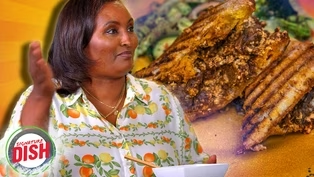
How Lemon Slice Cafe Makes Its Incredible Awaze Tibs Panini
Video has Closed Captions
Clip: S4 Ep6 | 4m 38s | Seth visits Ethiopian-American Lemon Slice Cafe in Silver Spring for the Awaze Tibs Panini Sandwich. (4m 38s)

How Lost Sock Roasters Makes Their Signature London Eye Latte
Video has Closed Captions
Clip: S4 Ep6 | 6m 16s | Seth visits Lost Sock Roasters for a behind-the-scenes look at the London Eye Latte. (6m 16s)
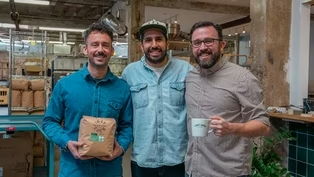
Preview: S4 Ep6 | 30s | Lost Sock in Takoma, Lemon Slice Cafe in Silver Spring, Rose Ave Bakery in Woodley Park. (30s)

The Secret Behind Rose Ave Bakery’s Famous Pandan Donut
Video has Closed Captions
Clip: S4 Ep6 | 5m 33s | Seth visits Rose Ave Bakery in Woodley Park to sample their signature pandan coconut donut. (5m 33s)
Providing Support for PBS.org
Learn Moreabout PBS online sponsorship

- Food
Christopher Kimball’s Milk Street Television
Transform home cooking with the editors of Christopher Kimball’s Milk Street Magazine.







Support for PBS provided by:
Signature Dish is a local public television program presented by WETA