Native Shorts
Monibimaadiziwin / Lichen
Season 4 Episode 4 | 26m 46sVideo has Closed Captions
Contemporary love story Monibimaadiziwin as well as the film Lichen.
On this episode of Native Shorts hosts Ariel Tweto (Iñupiaq) and Bird Runningwater (Northern Cheyenne/Mescalero Apache) discuss the contemporary love story Monibimaadiziwin as well as the film Lichen, a biological documentary shot for iMax.
Problems playing video? | Closed Captioning Feedback
Problems playing video? | Closed Captioning Feedback
Native Shorts is a local public television program presented by KVCR
Native Shorts
Monibimaadiziwin / Lichen
Season 4 Episode 4 | 26m 46sVideo has Closed Captions
On this episode of Native Shorts hosts Ariel Tweto (Iñupiaq) and Bird Runningwater (Northern Cheyenne/Mescalero Apache) discuss the contemporary love story Monibimaadiziwin as well as the film Lichen, a biological documentary shot for iMax.
Problems playing video? | Closed Captioning Feedback
How to Watch Native Shorts
Native Shorts is available to stream on pbs.org and the free PBS App, available on iPhone, Apple TV, Android TV, Android smartphones, Amazon Fire TV, Amazon Fire Tablet, Roku, Samsung Smart TV, and Vizio.
Providing Support for PBS.org
Learn Moreabout PBS online sponsorship- [Announcer] This series was created in partnership with the Sundance Institute.
More information at sundance.org Funding for "Native Shorts" was made possible by a generous grant from the San Manuel Band of Mission Indians, and from viewers like you.
(bold drumming music) ♪ (singing in indigenous language) ♪ ♪ ♪ - [Bird] "Native Shorts", presented by Sundance Institute's Indigenous Program.
- Hello and welcome to "Native Shorts."
I'm Ariel Tweto.
- And, I'm Bird Runningwater.
- And, today, we are gonna watch two films.
The first one is "Mino Bimaadiziwin."
and the second is "Lichen."
- Bird, can you tell us a little bit about the first one?
- Why, yes I can!
(laughs) You look cute.
- Oh, thank you.
- Well, "Mino Bimaadiziwin" is a short film by Ishkwaazhe Shane McSauby.
He belongs to the Grand Traverse Band of Ottawa and Chippewa Indians, which is Michigan.
- "The mitten?"
- The mitten, Lake Michigan are his ancestral lands, but he was born and raised in Grand Rapids, Michigan.
When he applied to the Sundance Native Lab with his short script, like amongst a pool of short film scripts, like, this one really stood out.
We're gonna talk about it after we watch the film.
- Cool, let's watch it.
- Okay.
"Mino Bimaadiziwin."
(film machine whirring/clattering) (graphic whooshes) (wind rushing/rustling) (wind rushing/rustling) - [Grandma] So much was taken away.
The land was taken away; so our lives were.
We lost our spirit.
We lost our love.
- [Young Jim] How do we get it back, Grandma?
- [Grandma] We have to rise.
Rise with each sunrise in prayer.
Follow the sunset with love.
[traditional drumming music] (soloist singing in Ojibwe) (group singing in Ojibwe) (traditional drumming music) (group singing in Ojibwe) ♪ (speaking Ojibwe) - I?
I don't.
♪ I'm good.
[group singing in Ojibwe] Oh, sorry.
I thought you were-?
You're native?
(speaking Ojibwe) Coffee.
(speaking Ojibwe) - I'm sorry.
I don't-?
I don't speak.
But, um?
Coffee?
We have some in the back, but it's not fresh.
(soft footsteps) (cup slides) On the house.
Do you really not speak English?
- Miigwech.
["Thank you"] (bell chimes) (door clanks) (nervous laugh) (items rustling) (placid music) - [Young Jim] Sunset?
- [Grandma] The sunset, it never discriminates.
It is always setting somewhere.
When we chase the sunset, we are always moving forward.
When you find it, you'll know.
You'll see its beauty, its knowledge.
Follow the sunset to find mino-bimaadiziwin.
- [Young Jim] Mino-bimaadiziwin?
- [Grandma] Follow the sunset to find the good life.
(traditional drumming music) (soloist sings in Ojibwe) ♪ (group singing in Ojibwe) (traditional drumming music) ♪ (group singing in Ojibwe) (traditional drumming music) ♪ - [Elder] Smudge?
♪ - I'm Jim, by the way.
(chuckles) - Jim?
- Yes, Jim.
You, um?
Who are you?
(speaking Ojibwe) (nervous laugh) - That's a long name.
(blinker clicks) (birds chirping) (shifter clicks) (key clanks) - [Jim] Where are we?
What are we doing?
(speaking in Ojibwe) (door thuds) - Of course.
(footsteps crunch leaves) (birds chirping) (wind rushing) (tranquil music) (birds chirping) ♪ (speaking in Ojibwe) (speaking in Ojibwe) (tranquil music) (birds chirping) ♪ ♪ [traditional drumming music] (group singing in Ojibwe) ♪ ♪ (soloist singing in Ojibwe) (traditional drumming music) (group singing in Ojibwe) ♪ (traditional drumming music) (group singing in Ojibwe) ♪ ♪ (group singing in Ojibwe) (traditional drumming music) ♪ ♪ [traditional drumming music] [group singing in Ojibwe] ♪ (door thuds) [music stops] - See?
That wasn't so bad, eh?
- [Jim] No, it was incredible.
I've never done anything like that.
Wait!
Did you just-?
You speak English?
Oh, my God.
(door creaks) (door thuds) (door thuds) - You should pack your bags and hit the road with me.
- Hit the road?
You just lied to me this whole time.
- Not even.
Didn't lie to you.
English isn't our language.
Anishinaabemowin is.
It's what connects us to the land, to the water, to our people.
Come with me, and you'll learn so much more.
We can learn from our elders.
- Just come with you?
Just-?
Just drop everything, and leave?
- [Bangishimogikwe] Why not?
- Well?
One, I have a job.
And, two, I still don't even know your name.
- My name is Bangishimogikwe.
(birds chirping) - Bangishimogikwe.
- So...?
You gonna come with me or what?
- Where?
- [Bangishimogikwe] To find mino-bimaadiziwin.
- So...?
What does your name mean?
- Sunset Woman.
(energetic music) ♪ (fast drums/ upbeat organ music) ♪ ♪ ♪ (music fades) (soft clapping) - [Ariel] Did he go?
- [Bird] I wonder!
- I say yes.
- Can you see why the script is so special?
- I can, for sure.
- Yeah.
It's a love story.
- I know.
I love "love" stories.
You love "love!"
- I know.
I love, love.
Yes.
But, you know, this is one of the reasons why back when I was at Sundance, amongst a pile of scripts of, you know, native and indigenous stories, like, this one really stood out.
Because it was a blossoming, budding, burgeoning love, you know, between two native people, which is sadly something we don't see enough of on screen.
- I was just gonna say that we don't see a lot of love stories and comedy, but this was like a good merger of both.
Yeah.
I really enjoyed this one.
- Yeah.
And, Ishkwaazhe's voice is really kind of centered primarily on the notion of decolonization, returning to language, returning to land, returning to culture.
And, you can kind of see those as really strong themes, you know, throughout the film.
- Yeah.
And then, the two actors there, I recognize both of them.
- Mm hm, mm hm.
Well, Grace Dove was interestingly on an ABC TV show with Hilary Swank.
- "Alaska!"
- Yes.
- Right?
- Yeah.
- "Alaska Daily."
- Yes!
- Yes!
- Yes.
Which, sadly, got canceled.
- Oh, it did?
- But-!
- Shucks.
- I know, but you know, that's great for her.
And, you know, and she was also in that Leo DiCaprio-- - Yep.
- Movie.
- Resonance?
- "The Revenant."
- Revenant!
- Yes.
So...and then Cleo, who plays Jim, is like a really interesting emerging, you know, actor who's doing really great things, as well.
- Yeah.
He has a great screen presence.
Nice cheekbones.
- Mm hm.
One of the interesting things about Shane is like, after he did the Native Lab and, you know, decided that, you know, he really needed to grow more as a filmmaker.
And so, he applied to and got accepted to NYU Film School in New York- - Awesome.
- Tisch School of the Arts.
And, has been there working on his master's degree, his MFA in film.
And, just most recently shot his thesis.
- Oh, wow.
- Short film, as well.
- So, we should keep our eye out for him.
- Oh, yeah.
He'll be doing some really great things.
- Awesome!
Well, I think (claps) we should jump into the next film.
- Okay.
- "Lichen."
- "Lichen."
- And then, we'll come back and discuss all things lichen.
- Okay.
Let's do it!
- Perfect!
(laughter) (film machine whirring/clattering) (birds chirping) (tranquil keyboard music) ♪ ♪ (placid organ music) ♪ ♪ ♪ (soft rapid organ music) ♪ (water rippling sounds) (soft rapid organ music) ♪ (tranquil music) (water trickling sounds) ♪ ♪ (soft calm organ music) ♪ (birds chirping) (calm organ music) (calm organ music) ♪ - [Trevor] I like to say that lichens colonized the surface of my mind.
(crickets chirping) (tranquil organ music) ♪ The lichen is the outward manifestation of process.
It's verbal.
It's not a thing; it's a relationship.
♪ It exists at a kind of doorway.
♪ And, when you look out this doorway in one direction, what you see is the organism.
But, you look out the doorway in the other direction, and you have the ecosystem.
(crickets chirping) (tranquil organ music) ♪ (bird calling) (birds chirping brightly) (soft rapid percussion music) (water rippling sounds) ♪ (rapid looping organ music) ♪ - [Trevor] A lichen is a fungus that's discovered agriculture.
Well, the fungus has an ability to acquire algal cells.
The algal cells, of course, being green and photosynthesizing.
They're producing sugars.
They help to feed the fungus.
Together the two of them can do amazing things.
♪ That frees them.
It frees both partners from living on the ground.
(soft rapid looping organ music) ♪ ♪ The lichen covers the widest array of ecological niches, you know, right down to the Antarctic.
♪ Higher than anything else in the Himalayas.
♪ They occupy the spaces in the living world where other organisms can't grow.
(soft rapid looping organ music) ♪ They're very poor at competing.
They're easily overgrown.
♪ What keeps 'em together is adversity.
♪ Every lichen has a conversation with place.
But because every place is different, the conversation has to be different.
(soft rapid organ music) (water rippling sounds) ♪ If you think long and hard about lichens, you can actually hear the conversation.
You can kind of play it back, how it must have been long before there were people.
(birds chirping) In some cases, long before there were dinosaurs.
(water rippling sounds) (birds calling) (light tranquil organ music) ♪ (light ethereal organ tone) ♪ ♪ ♪ ♪ (low humming tone) ♪ (storm rumbling) (thunder cracking) (rain pattering sounds) (light mysterious organ tone) ♪ (eerie music) (tone resonating) ♪ ♪ (light peaceful organ tone) ♪ ♪ (soft bright piano tones) ♪ ♪ - [Trevor] The oldest lichens in the world have been sitting in place since the ice left.
So 9,600 years.
(delicate piano tones) ♪ There are places in the Arctic where a lichen might grow a millimeter in a century.
(tranquil organ music) ♪ - When you look closely, you don't see the thing; the thing that is the lichen disappears.
You lose what scientists have since then increasingly come to call emergence, or the emergent property.
♪ It's not-- It's not the parts.
You can never predict from the bits and pieces within it, how it's going to behave.
(peaceful organ music) ♪ Emergence is everywhere around us, in everything that lives.
And, if you live long enough with this, you start to see the world in a quite different way.
The idea that the world has agency, so that things are always in the process of becoming.
(light tranquil organ music) ♪ (soft bright piano tones) (birds chirping) ♪ ♪ (birds chirping) (soft bright piano tones) ♪ (birds chirping) (light placid organ music) ♪ (water splashing gently) (light calm organ music) ♪ (birds singing) (soft peaceful organ music) ♪ (birds singing) (water splashing gently) ♪ (light warm keyboard music) ♪ ♪ (light warm keyboard music) ♪ - [Ariel] Well, I am likin' this one!
(Bird laughs) I had to!
Oh!
"Lichen", though?
It's fascinating.
It blows my mind.
I'm obsessed.
- Yes.
- Yeah.
- There's a lot of lichen in Alaska, right?
- Oh, tons!
Well, a little bit now 'cause I ate most of it.
No, I did.
I'm part caribou!
- You eat it?
- You can.
Most people don't.
- Wow.
- But, yeah.
Lichen's just fascinating.
And then, this whole-- I mean, this film was very beautiful.
- Yeah.
- Tell us a little bit about it.
- Well, it's so interesting this film.
'Cause I've known Lisa Jackson, the director, as a filmmaker for quite a while.
She's Ojibwe and from Canada.
And, most of her work throughout her body of work really has always kind of honed in on the Canadian residential school, descendancy experience, you know, and all of the trauma and those things.
Which is very important stories.
But, for this film, you know, she made such a really interesting departure from her usual storytelling voice.
And, decided to tell a story about lichen, which is sometimes as old as the dinosaurs, right?
- Yeah.
Some could live till, like, 8,000 years old.
- Yeah.
- Like...(gasps) - And, she shot it for IMAX, for an IMAX experience.
You know, so it's beautifully done in studio.
Beautifully lit.
So, if you get a chance to see this on the big screen, please do.
- Yes.
I'm going to see it again.
- Alright.
- Thank you all so much for watching.
And, I can't wait for the next episode.
Hope you can't wait, either!
Until then... - [Bird] Goodbye.
- [Ariel] Bye.
(singing in indigenous language) ♪ - [Ariel] Today, I wore a skirt and top by Kinyaa'aanii by Sheena Taylor, earring hairpiece by Clarissa Azure.
- [Bird] And today, I'm wearing a necklace and earrings by Tania Larsson, and a bracelet by Molina Two Bulls.
♪ - [Announcer] This series was created in partnership with the Sundance Institute.
More information at sundance.org Funding for "Native Shorts" was made possible by a generous grant from the San Manuel Band of Mission Indians, and from viewers like you.
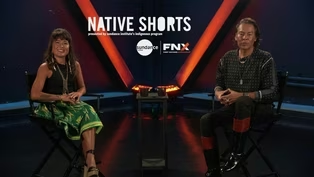
Monibimaadiziwin / Lichen Preview
Preview: S4 Ep4 | 30s | Contemporary love story Monibimaadiziwin as well as the film Lichen. (30s)
Providing Support for PBS.org
Learn Moreabout PBS online sponsorship










Support for PBS provided by:
Native Shorts is a local public television program presented by KVCR