
On Their Own Terms
Season 2 Episode 13 | 21m 7sVideo has Closed Captions
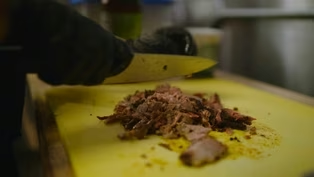
A barbecue pitmaster and artist carve their own paths to find success.
A barbecue pitmaster finds success against all odds. An artist carves his own path and, in the process, puts the Houston art scene on the map.
Problems playing video? | Closed Captioning Feedback
Problems playing video? | Closed Captioning Feedback
Production Support Provided By: Riptide Waters LLC; Texas Parks & Wildlife Foundation; Texas Rural Funders, H-E-B”
On Their Own Terms
Season 2 Episode 13 | 21m 7sVideo has Closed Captions
A barbecue pitmaster finds success against all odds. An artist carves his own path and, in the process, puts the Houston art scene on the map.
Problems playing video? | Closed Captioning Feedback
Where to Watch Texas Monthly Presents: The Story
Texas Monthly Presents: The Story is available to stream on pbs.org and the PBS app.
Providing Support for PBS.org
Learn Moreabout PBS online sponsorship- He goes where his obsessions take him.
There's a reason why things happen the way they do.
- You stay on the road 'til you run out of gas.
(fire smoldering) (tense music) (knife tapping) - How do I get all this in one photo?
I don't know.
This restaurant is out of place.
- I am the bird standing on a cedar- - Cedar stump.
(birds chirping) (tense music) - (laughs) He's going to just do it his way.
(laughs) (tense music) - That's no different from how we create here.
- [Katy] And in a big way.
(leaves rustling) (birds chirping) (suspense music) (suspense music) (water trickles) (gas switch clicking) (flame ignites) (energetic music) - [Daniel] Barbecue's a competitive industry.
There are so many joints that open up all over the state.
You need to differentiate yourself in some way.
(energetic music) The places that create for themselves a great story are the ones who really use the identity of the people who are doing the cooking.
(seeds whirring) This restaurant is out of place.
Like, it's out of place in the realm of barbecue.
It's out of place in the realm of a taqueria.
It's out of place in Downtown Midland.
(vehicle whooshing) - We're creating and doing something that represents me, represents us.
(energetic music) - [Daniel] I'm Daniel Vaughn, barbecue editor at "Texas Monthly," and I wrote about Midland's Barbecue Maverick.
(people chattering) (lively music) (people chattering) (lively music) When it comes to barbecue in Midland, it's usually pretty straightforward, right?
You got meat platters or barbecue sandwiches.
It really doesn't get much more interesting than that.
(people chattering) (lively music) Ruben never really thought of Pachuco's as a barbecue spot, or at least primarily a barbecue spot.
- I've lived so many places, and I've done so many things, and I've grown up around a bunch of different people, and I pull influence from all that stuff.
We didn't sell barbecue until we opened the doors here.
So, I learned off a pellet grill in the food truck.
(energetic music) - If you're smoking meats and serving them to the public, then I might show up and write about it.
(people chattering) (lively music) You see a menu like Pachuco's, and you think, "Okay, either this chef or pitmaster has a complete lack of direction or has ultra confidence.
Hello.
- How are you?
- How are you?
- I'm great.
- All right.
So much to choose from.
I got to try the Korean Loco Moco.
And in Ruben's case, it's that confidence to put out this huge variety of food and do it well.
- I just make fun food that I would want to eat.
(people chattering) (lively music) - Oh- - Here's your first course.
- Hi, first course.
(server laughs) Oh, wow.
Okay.
- That's going to be the chili pot pie.
- This is a personal-size pot pie.
- Yes.
- So much of what I see in Texas barbecue is copycats, right?
They're looking toward an example that's been successful and trying to replicate it in some way.
But at Pachuco's, there is so much variety.
It is like the most nonconformist barbecue menu you can imagine.
Oh, my, all right.
We're going to need, like, a... (people chattering) (lively music) All right.
Let's... (people chattering) How do I get all this in one photo?
I don't know.
(people chattering) (restaurant ambience) That is massive.
(laughs) (people chattering) Ruben was working in the oil fields, but he had this dream of opening a restaurant.
(gentle music) He decided to start first with a food truck long before the brick-and-mortar Pachuco's opened.
- We had a little bit of money back in 2019 at the beginning of it.
So we just started talking about, "Hey, let's make a business to kind of change the path of our family."
- [Daniel] One of the people who really encouraged him to change careers and open up this food truck was his brother, Jeffrey.
- Finally, he's like, "Gino, just make your food truck like you've always talked about."
And he had pulled out the money.
I sent him a deposit for it, and unfortunately, that's the same day my brother passed away, which... And it's the same day that we became a legal company in Texas, July 19th, 2019.
(gentle music) It's just strange how life, you know, sends these things to you.
(gentle music) - His brother was his biggest cheerleader.
(gentle music) - To Jeff, Ruben was his dad, his brother.
He was everything to Jeff.
(gentle music) And he's part of this restaurant because if he hadn't pushed him like he did, he wouldn't have done this.
He would've still been working in the oil field or doing something else, you know?
- If you have somebody who's pushing you toward a dream and they die, you're gonna feel a necessity to see it through, right?
You're gonna feel like that is an homage to them, and that's what Ruben did.
- There's a reason why things happen the way they do.
I would've never had a food truck if it wasn't for my brother, you know?
- The food truck did really well for him.
Like, he outgrew it pretty quickly and started looking for a brick-and-mortar.
(vehicle whooshing) The story of Pachuco's is really laid out in front of you as you walk in from the parking lot.
(energetic music) You see a mural outside that features his brother Jeffrey, among other Pachuco's.
(energetic music) Pachuco is a movement of Mexican Americans, Chicanos, who were in the US.
They felt like they were being forced to conform to an American lifestyle, but they didn't really want to assimilate.
(energetic music) - Pachuco's, they pulled influence from things that they liked, and they created their own way of talking, their own way of living, their own way of interacting.
(lively music) - [Daniel] They wanted to be able to express their own identity, and that is what Pachuco's represents in Midland.
(lively music) - To mix this new way of living, being Mexican American, that's no different from how we create here.
- Ruben is, like, a sort of mad scientist of food fusion.
Elotes have gotten really popular in barbecue, but they do it the right way.
It starts with an ear of corn, still on the cob, that gets roasted, coated in cotija cheese.
It's, ah, it's so good.
(meat sizzles) The burger patty on the Loco Moco, it actually comes on a bed of kimchi fried rice.
(lively music) And this is a barbecue joint, mind you.
As far as ribs, they actually take the smoked spare ribs, batter them, deep-fry them.
(batter fries) (lively music) And cover them in a sriracha honey.
(lively music) Then there's this full burger menu.
The one that is the highlight of the menu is the "I Got Jeffed."
- [Ruben] The "I Got Jeffed" is named after him, so it's like two pounds.
His favorite thing to eat was Whataburger, you know, just meat, cheese, (laughs) and ketchup.
He was very picky.
- Much like the movement of Pachuco's, Ruben is not assimilating to what people expect from a taqueria or from a barbecue joint or from a burger joint.
Like, he's just really putting his own voice to all of it.
(lively music) - All right, what's going on?
- Hey, Ruben, how's it going?
- Pretty good.
Welcome.
- You've interrupted me mid-meal here, but there's a lot to get through.
- No, it's a lot.
It's hard to get something new in food when it's all been done, and it's all been done great.
When everything's been done great, and you have these standards, you got to focus on what are you doing?
What, who are you, right?
And this is who I am.
We got about 10 minutes.
You know, I have a lot of local ingredients and just trying to do something different and introduce people to the flavors in West Texas that traditionally aren't here.
(lively music) I get really excited about that stuff.
Smoking unconventional things that shouldn't be smoked or haven't been smoked yet.
(lively music) - The food that you serve other people, whether it's at home or a restaurant, is an expression of yourself, right?
- Man, I'm just trying to be me.
(people chattering) (lively music) Y'all all right?
- Great.
- Good deal.
Appreciate it.
(people chattering) (energetic music) - Texas has a deep history of barbecue, and sometimes people who deem themselves traditionalists try to make rules about the way it should be cooked and served.
But I think what really makes Pachuco's a Texas story is because he's a maverick.
- Cooking's a safe place for me.
This kid that came from hardships, and you know, wasn't supposed to be able to do any of the stuff that I've done, here I am, making Texas barbecue (laughs) my way.
If it makes sense, do I have the capability to do it?
Can I figure it out?
We're going to do it.
(eerie music) (vehicle whooshing) (paper rustling) (lively music) - [Katy] Anytime you find a subject who has a singular purpose and doesn't really waver from that, no matter what, you're going to have a good story.
(lively music) He just has an engine unlike anything I've seen up close before, totally uncompromising.
- It's unimaginable to me that any creative person would retire or quit.
You stay on the road till you run out of gas.
(vibrant music) - He's going to just do it his way, and in a big way.
(vehicle whooshing) (energetic music) I'm Katy Vine.
I'm a staff writer at "Texas Monthly," and I wrote, "A Portrait of an Artist as an Old Man."
Around 2017, I started getting emails.
They seemed to be transmissions from outer space, as best I can tell, (laughs) and they were almost like free-form poems.
I think the emails just piqued my curiosity.
One example, "I am the bird standing on the- - Cedar stump."
What makes the clock think out loud?
(birds chirping) (eerie music) - It was just so weird, and I loved it.
I felt a little bit like this person was trying to say something to me.
- [James] Am I the back of working hands showing scars from picking the roses?
(eerie music) - I think I knew who James Surls was, but I had never done a deep dive on his work or his life.
(energetic music) James Surls is a legend in the art world in Texas.
He really rose in popularity in the '70s.
I think at the time, nobody was paying any attention to Texas artists, and even some Texas museums weren't paying attention to Texas artists.
(energetic music) He is one of the major players, not just because of his own work, but the work that he did in Houston inspired so many other artists.
(energetic music) (vehicle droning) (bird squealing) At a certain point, I thought, "I am interested enough to meet this guy."
- Hey, Katy.
- Hey.
It's been a while.
How are you?
- I'm good, thank you.
- Good, good.
- How are you?
- [Katy] Splendora is basically the woods up north of Houston, and that is where James built his sort of compound.
I always wanted to see Splendora since that was the inspiration for a lot of the early work or the mid-era work.
- We started this building in the late '70s.
We finished it in '84.
- [Katy] It has history for the family, for James as an artist, and then also the art world has been out there.
(eerie music) (birds chirping) (leaves rustling) - [James] You know, as an artist, I conjure from this environment.
I grew up in it.
It was... I played in it as a child on creek beds and in woods, and they are my people.
(birds chirping) (leaves rustling) The trees are my relatives.
(birds chirping) (leaves rustling) (lively music) - I think I described James as being kind of like Paul Bunyan.
He's huge.
At one point in his life, he had, you know, long hair, and he had, I think, some kind of bone or something and an earring.
(energetic music) James has never worked small.
(laughs) This is just his vision.
There's no getting around it.
Once I met him, the way that he interacted with his work and talked about it, he touched it a lot.
These are like living things for him, and it's really just funny to see him in the middle of it.
And that was actually the most powerful experience I had with James's work, was seeing it all bunched together.
(energetic music) He gave me a really easy entry point into the world that he was expressing.
- I was coming through New Mexico seeing these high-line poles, but I looked at them as, like, a creature, a man standing out on the horizon.
(eerie music) And so I thought of this.
When I got back to Dallas, I made this.
- I think James had a lot of luck, a lot of being in the right place at the right time.
Once he realized that sculpture was his thing, it's all he thinks about, it's all he wants to do.
And so he's sitting in a bar in Dallas, and it just happens.
I mean, maybe destiny, right?
This sculpture teacher from SMU says basically, "Would you like my job?"
- He said, "Well, what do you do?"
And I said, "Well, I'm a sculptor."
And he said, "Oh, so am I."
He said, "Well, I'm the sculpture teacher at SMU, and I want to take the summer off.
Do you want my job?"
(Katy laughs) - When James is in Dallas working at SMU, he meets a young artist named Charmaine Locke, and she becomes his lifelong muse and partner.
(energetic music) He was still in Dallas, I think, when he meets his next big break, Jim Harithas, the very, very influential curator.
- It was in my studio in Dallas, and Jim Harithas called and said he wanted to come visit.
- Who was Harithas?
Can you talk about that?
- I didn't really know who Jim Harithas was, to tell you the truth, at the time.
He was the new director of the Contemporary Arts Museum in Houston, and Harithas didn't say a word.
He walked around for 15 or 20 minutes and just looked.
And then he came over to me, and he looked at me, and he said, "Well, you're ready.
I got a museum show at the Contemporary Arts Museum in Houston with six weeks' notice, but I had all the art.
I had a body of work."
- During the show, everybody said, "Oh, your work is so wonderful, so wonderful."
But I don't think they bought much because he... I think his comment was, "If you could only eat wonderful."
He definitely had to navigate that as a strong-willed person who did not want to compromise, but also had a reality of feeding kids and paying the bills.
- Artists think about where and who they sell to, but that's not the reason that I make what I do, because my market is so thin and so scattered that, I dare say, 99.9% of humanity, it's not for them anyway.
They can't put this in their living room.
(lively music) So consequently, who do you make it for?
That's not a lightweight question.
I'm looking for one person on the planet.
It's a little thin margin of the world out there.
- I think one of the things that I love about James is that he doesn't really compromise what he feels he needs to express.
He goes where his obsessions take him.
Moving to Houston was a huge turning point for James.
He gets a show at the Whitney Biennial.
He starts working at U of H as a professor.
While he's at U of H, the art building burns down.
So James gets a massive warehouse, which he then turns into the Lawndale Arts Center.
(energetic music) What was going on at Lawndale at that time that he'd created that got you interested?
- Lawndale was a sweet spot in the history of Houston art.
Lawndale became a place where anything could happen.
- He said the beauty of Lawndale, at that time, was all his job was to sit back and say yes.
And that was a huge gift to anyone who wanted to work in a visual medium at that time.
- You know, James Surls's impact in Houston and in the state, and I'd say even in the United States, is far-reaching.
He's inspired so many people.
His work is inspirational because of its beauty and its size and its effort.
(gentle music) - Now that he's at this stage in his career, he's really thinking a lot about how it's going to be perceived, I think, when he's gone.
(gentle music) (coffee rattles) (water streams) (switch clicks) (coffee dribbles) (birds chirping) (gentle music) James is 83 now.
It's probably fair to say that these next couple of decades are important to sort of sealing his career.
(leaves rustling) (birds chirping) (gentle music) - I want to come home.
I mean, this is my home.
Charmaine and I built this place from the ground up, literally from the ground up.
(gentle music) We started here with bare bones.
(gentle music) Very romantic encounter for two people in love, building a life.
(gentle music) "Poem for Charmaine."
"There's always a beginning.
I start my life from under the oaks, pines, magnolias, hollies.
We drank from wonder and splendor.
All we ever really wanted was to be home with the other," James Surls.
(gentle music) (leaves rustling) It was a storybook place to build a life.
Why would I not want to come home?
I mean, this is home.
(birds chirping) (leaves rustling) (gentle music) - Splendora had been his home and his studio for so long, and now he wants to turn it into this museum and basically an anchor for his legacy.
(birds chirping) (leaves rustling) (gentle music) So while that's really hard, nobody's more passionate about that work than he is, and so he knows he's the one who can do that job.
- I get to get up in the morning- - Yeah.
- And do what I love doing.
And even at my age now, in the mid-80s, I'm not going to retire because I love what I do.
- Here he is in his 80s, and he's also got another big show coming up where it's going to have, you know, 25 giant sculptures, one that's like 15,000 pounds.
- I still have my hands.
I still have my head.
I'm still working.
I still function.
I'm feeling really good about the future.
- Yeah.
- You know, I've got a lot on the table.
- James is just a classic example of that kind of maverick spirit.
(gentle music) He just is sort of like a steam engine going 100 miles an hour, and there's no stopping it.
I am following my own curiosity, and that's always the payoff for me.
It was really moving to me to see the energy and the devotion to a path... (gentle music) And a connection to something much bigger than himself.
(gentle music) He just, he's sort of otherworldly, you know?
(leaves rustling) (gentle music) And I would love... I would love to have just more people know about him.
(leaves rustling) (gentle music) - [Daniel] I write a lot about barbecue, but in the end, I'm a storyteller.
(lively music) When I find someone who's doing things on their own terms and their own way, it just makes a lot more interesting story.
(lively music) - It's a very simple burger, too.
It's just, it's named after my brother.
- I think there is a do-it-yourself spirit in Texas, going with your gut and not compromising.
You can just be you, and that's your superpower.
(vibrant music)
Video has Closed Captions
Preview: S2 Ep13 | 30s | A barbecue pitmaster and artist carve their own paths to find success. (30s)
Providing Support for PBS.org
Learn Moreabout PBS online sponsorship









Support for PBS provided by:
Production Support Provided By: Riptide Waters LLC; Texas Parks & Wildlife Foundation; Texas Rural Funders, H-E-B”