Modern Gardener
How to Get Free Pollinator Plants
Episode 129 | 8m 1sVideo has Closed Captions
Supporting Utah pollinators has never been easier or more affordable, thanks to this free program.
Supporting Utah pollinators has never been easier or more affordable, thanks to a free program offered by the Utah Department of Agriculture and Food. If your application is selected, you are the proud owner of 90 – yes, 90 – pollinator-friendly plants and flowers for your yard!
Problems playing video? | Closed Captioning Feedback
Problems playing video? | Closed Captioning Feedback
Modern Gardener is a local public television program presented by PBS Utah
Funding for Modern Gardener is made possible in part by Merit Medical and Red Butte Garden & Arboretum.
Modern Gardener
How to Get Free Pollinator Plants
Episode 129 | 8m 1sVideo has Closed Captions
Supporting Utah pollinators has never been easier or more affordable, thanks to a free program offered by the Utah Department of Agriculture and Food. If your application is selected, you are the proud owner of 90 – yes, 90 – pollinator-friendly plants and flowers for your yard!
Problems playing video? | Closed Captioning Feedback
How to Watch Modern Gardener
Modern Gardener is available to stream on pbs.org and the free PBS App, available on iPhone, Apple TV, Android TV, Android smartphones, Amazon Fire TV, Amazon Fire Tablet, Roku, Samsung Smart TV, and Vizio.
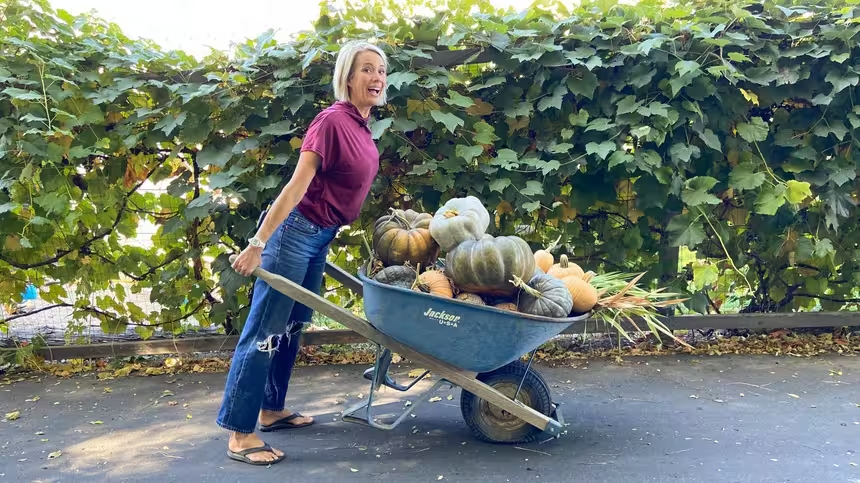
Modern Gardener
Subscribe to the Modern Gardener YouTube channel for more videos and information on gardening, and share your gardening tips and stories in the comments section. Can't wait to GROW with you!Providing Support for PBS.org
Learn Moreabout PBS online sponsorship[Cynthia] Did you know that the state of Utah has a program where you, yes you, can create a beautiful pollinator paradise?
It's a free program with the Utah Department of Food and Agriculture, and we are gonna learn all about it, that you can get a bunch of free plants.
Free plants.
I am so excited to have Mindy here.
Mindy, I know you as a legend.
- Yeah, oh my.
- We've talked about this before, but I've known you, and she knows so much and I'm so excited to have you here.
But let's get into it.
Tell me what exactly is the Pollinator Habitat Program?
[Mindy] It is a program started by the Utah Department of Agriculture and Food to boost pollinator habitat and pollinator numbers as well as diversity because our pollinators are in some pretty serious decline.
And we also really wanted to concentrate on native plants and native p ollinators.
There's like at least 1,000 other native bees here in Utah.
[Cynthia] Wow.
That we're also concerned about in addition to, of course, the monarch butterflies that are in decline, as well as so many of our other pollinators that really need our help in creating their habitat, some food, some shelter for them.
So that's what this program is all about.
[Cynthia] So how is one able to be a part of the pollinator program?
[Mindy] We put a application up for anyone on the UDAF website starting in March 1st to April 15th.
- Okay, put that on your calendar.
- There you go.
We do have a hard stop on April 15th for those applications to come in.
[Cynthia] Okay.
[Mindy] Really, anybody can apply, homeowners, businesses.
We have non-profits applying.
[Cynthia] Wow.
[Mindy] We have some involvement from some of the state agencies trying to revegetate around the Great Salt Lake and Utah Lake.
So there's a lot going on.
[Cynthia] Wow, this makes me so excited.
I got goosebumps, like truly.
We're hoping to touch as many people as we can.
[Rhea Cone] I am out watering hundreds of pollinator plants that we were awarded as part of Utah Pollinator Habitat Program.
[Mindy] We generally let people know the first week in June whether they were accepted or not, and so far.
- Where they have won a big award.
A major award.
- Like a woo, a great, you know, with congratulations.
And the past few years we've had about a 70% acceptance rate.
[Cynthia] Oh my gosh.
So it's not like a one person's gonna win this, okay.
There's 70% of the applicants.
[Mindy] It's pretty, yeah, it's pretty exciting.
[Cynthia] It's a good prize.
[Mindy] And then the plants are grown over the summer and are taken to certain drop off spots where people come and pick them up.
[Cynthia] Okay, so it's like picking up groceries.
You go pick up your plants.
[Mindy] Right, and you'll come pick up your plants in, depending on where you are in the state between mid-September and early October.
It's a minimum of 90 plants.
So something to keep in mind.
[Cynthia] What?
[Mindy] Yeah.
90 plants.
[Mindy] 90 plants.
- That's a lot.
- Yeah, it is a lot.
- That's amazing.
- Last year we were dealing with about 90,000 plants.
[Cynthia] Wow.
- To like sort into kits and.
- But that is crazy to me.
90 plants that you're gonna get for your space.
- Yeah.
- Four or five minutes of your time filling out an application.
- Right.
- This is like win, win, win, win, win.
- Yes, exactly.
- Okay, awesome.
- And they're all native plants too, so they should all take a lot less water than your.
[Cynthia] Typical.
- Than what you might be.
[Cynthia] Than the petunias?
- Taking out.
- [Cynthia] Yeah.
(Mindy laughing) What kind of plants are you getting?
[Mindy] Yes, so I have it right here.
- Look at this.
- This is also up on our website, Utah Pollinator Habitat Program.
Just Google it, it'll take you to this and much, much more.
[Cynthia] Awesome.
- So these are all native plants, right?
And so we have four types of kits.
We have a Northern Utah Upland kit, a Southern Utah Upland kit, 'cause St.
George is very different than Logan.
Right?
[Cynthia] Oh yes.
A little bit.
[Mindy] And then we have a Northern and Southern Wetland kit.
[Cynthia] I wanna know, like what kind of plants are there?
Get me excited, Mindy.
- Penstemons, they're all about Penstemons.
- Penstemons.
Everybody's loving the Penstemons.
- Beardtongues.
- Yes.
- I don't know if how many people, but Utah is like world central in Penstemons, right?
[Cynthia] Ooh.
[Mindy] They all emanated from here.
[Cynthia] Look at that.
[Mindy] So we have, I don't know, about 80 species of Penstemon in Utah.
[Cynthia] That's amazing.
And a lot of them are garden friendly or certainly pollinator habitat friendly.
So we have.
[Cynthia] That's so cool.
[Mindy] Firecracker Penstemon, Rocky Mountain Penstemon, Palmer's Penstemon, Dusty Penstemon, working on others too.
[Cynthia] Oh, like colors of the rainbow.
That's so great.
[Mindy] There's Globe Mallow.
[Cynthia] Oh yes.
[Mindy] Really beautiful orange ones that get the little Globe Mallow bees in them.
[Cynthia] Yep, yep.
We have Showy Goldeneye, which is a great summer bloomer.
The main thing is that we wanted, we chose plants to make sure that people had blooms.
[Cynthia] That's what I was gonna say.
- Throughout the entire.
- [Cynthia] When I looked at the list.
- [Mindy] Yeah.
- I'm like, they were thinking on this.
Okay, this is not just like haphazard gonna throw some plants in there.
You get the spring, you get the summer, and you get the fall blooms on these.
And that is so important, especially for all of our pollinators.
- Right, right.
We're trying to bring a little bit more of that back and so the pollinators have something to feed on in the fall as well.
[Cynthia] That's amazing.
So Mindy, I am putting it out into the universe that I get this and I am awarded 90 plants.
What are my next steps?
[Mindy] So getting rid of your sod or clearing an area, just making sure that you have your space cleared.
And boy, you know, the more you can do to get rid of your weeds and your sod ahead of time.
[Cynthia] The bindweed.
[Mindy] The better, yes.
The bindweed is a really tough one.
[Cynthia] It's loving its life.
[Mindy] But we also would like people to not use weed mat.
- Yes.
- Because a lot of our native bees are ground nesters and they need access to the ground to burrow in and make their nests out of.
- You can't make a pollinator habitat if you're blocking the entrance.
[Mindy] Exactly, yeah.
You need homes for those native bees.
[Cynthia] So what about water?
- When you pick up your plants, we do have a planting and maintenance guide.
- [Cynthia] Awesome.
- And it will sort of tell you how often you need to water those plants at least until they get established, right?
[Cynthia] That's probably why you guys give them in the fall too, to help with that.
- Exactly, because we don't, yeah, because.
- Just making those connections, Mindy.
- Right, there you go.
There's a couple of, a number of plants in these kits that they don't like to extra water.
They will die.
[Cynthia] And what I find are people are generally over waterers.
[Mindy] Yes.
- That's, I generally find when people are having problems with their garden.
- [Mindy] Right, just needs more water, yeah.
- It's, no.
- [Mindy] Not the case with a lot of these native plants.
[Cynthia] Who benefits from this?
I want like, not only just the homeowner, but tell me how this program is a benefit for the state of Utah.
- It's just become so wide ranging.
I have a team that collects seeds from some of these native plants.
Then these seeds go to the prison, the state prison.
- [Cynthia] Oh wow.
- [Mindy] Who grows them out for us.
- [Cynthia] That's really awesome.
- They are doing a fantastic job of it.
The horticultural program is a big one out at the state prison there.
Then they of course come back to lawns and we give little signs to go out, and so people can walk by them and do the QR code and learn more about program.
It's so, so much about education.
[Cynthia] Obviously the pollinators are benefiting, number one.
[Mindy] Yes, absolutely.
[Cynthia] But then there's a community that's growing with it.
And then I love the QR code as this educational component that people are like, oh, this is how I get involved.
This is why this garden's here.
That is awesome.
[Mindy] The other aspect of this program is that we ask people to commit to three years to tell us.
And we send them a reporting form every year.
What species, what plant species did well, what plant species did not do well.
[Cynthia] Okay.
- In both our Upland and Wetland kits because in the background there's a whole bunch of research going on in terms of what native species are gonna do well for restoration purposes, for pollinator purposes, as well as for home gardens.
- I hope this episode inspired you to apply for the Utah Pollinator Program and thanks for watching.
(upbeat music)


- Home and How To

Hit the road in a classic car for a tour through Great Britain with two antiques experts.











Support for PBS provided by:
Modern Gardener is a local public television program presented by PBS Utah
Funding for Modern Gardener is made possible in part by Merit Medical and Red Butte Garden & Arboretum.