
May 14, 2026 - PBS News Hour full episode
5/14/2026 | 57m 46sVideo has Closed Captions
May 14, 2026 - PBS News Hour full episode
May 14, 2026 - PBS News Hour full episode
Problems playing video? | Closed Captioning Feedback
Problems playing video? | Closed Captioning Feedback
Major corporate funding for the PBS News Hour is provided by BDO, BNSF, Consumer Cellular, American Cruise Lines, and Raymond James. Funding for the PBS NewsHour Weekend is provided by...
May 14, 2026 - PBS News Hour full episode
5/14/2026 | 57m 46sVideo has Closed Captions
May 14, 2026 - PBS News Hour full episode
Problems playing video? | Closed Captioning Feedback
How to Watch PBS News Hour
PBS News Hour is available to stream on pbs.org and the free PBS App, available on iPhone, Apple TV, Android TV, Android smartphones, Amazon Fire TV, Amazon Fire Tablet, Roku, Samsung Smart TV, LG TV, and Vizio.
Providing Support for PBS.org
Learn Moreabout PBS online sponsorshipGEOFF BENNETT: Good evening.
I'm Geoff Bennett.
AMNA NAWAZ: And I'm Amna Nawaz.
On the "NewsHour" tonight: China offers President Trump a grand welcome, but also warning over U.S.
support for Taiwan.
GEOFF BENNETT: The new generation of reality TV stars is trying to turn on-screen fame into political power and reshaping the way campaigns are run in the process.
ROXANE GAY, Author: There's not a lot of reality to be found yet in reality television.
And, quite frankly, there's not a lot of reality to be found in politics, and so it's a very unholy union.
AMNA NAWAZ: Plus, the expected closure of the so-called Alligator Alcatraz detention center and a change in Border Patrol leadership, the latest developments in the Trump administration's immigration policy.
(BREAK) AMNA NAWAZ: Welcome to the "News Hour."
Chinese leader Xi Jinping hosted President Trump today and offered the U.S.
a -- quote -- "new vision" of relations, more focused on trade and collaboration than on confrontation.
GEOFF BENNETT: President Trump, in turn, offered a future in which he and Xi were, in Mr.
Trump's words, united and together.
But China's president also had a stark warning to his American counterpart about Taiwan.
Nick Schifrin is in Beijing again for us tonight.
NICK SCHIFRIN: Today, through empty streets, an American president arrived in the heart of Beijing to fanfare and an outstretched hand.
Xi Jinping and President Trump met at the Great Hall of the People, the ceremonial center of communist China.
The goose-stepping was synchronized, the cheering choreographed.
And two geopolitical rivals suggested they both wanted a new era where confrontation could be replaced by collaboration.
It's been nine years since any American president came here, and the relationship between the United States and China has become much more fraught since then, in part because of President Trump's policies.
But President Trump today seems to be coming here determined to make deals, and the Chinese are determined to bring out all the pomp and circumstance.
DONALD TRUMP, President of the United States: It's an honor to be with you.
It's an honor to be your friend.
And the relationship between China and the USA is going to be better than ever before.
NICK SCHIFRIN: At an expanded bilateral meeting, President Trump and Xi Jinping echoed each other, what Xi labeled a new vision for bilateral relations.
XI JINPING, Chinese President (through translator): China and the United States should be partners, instead of rivals, helping each other succeed and prosper together.
NICK SCHIFRIN: But in the Chinese readout of the meeting, Xi Jinping delivered a warning about Taiwan - - quote -- "If it is handled properly, the bilateral relationship will enjoy overall stability.
Otherwise, the two countries will have clashes and even conflicts, putting the entire relationship in great jeopardy."
Xi didn't specify his demands, but U.S.
officials say China wants President Trump to block a future Taiwan arms sale and, if possible, change U.S.
diplomatic language from "We don't support independence for Taiwan" to "We oppose independence for Taiwan."
Today, Secretary of State Marco Rubio told NBC there would be no policy change.
MARCO RUBIO, U.S.
Secretary of State: From our perspective, any forced change in the status quo and the situation that there now would be bad for both countries.
NICK SCHIFRIN: But if there were any tensions today over Taiwan, technology or trade, they were not public.
DONALD TRUMP: China is beautiful.
NICK SCHIFRIN: And at a lush state dinner, the two leaders both connected centuries of history to a shared future.
XI JINPING (through translator): We agreed to build a constructive China-U.S.
relationship of strategic stability to promote the steady sound and sustainable development of China-U.S.
Relations and bring more peace, prosperity and progress to the world.
DONALD TRUMP: This bond of commerce and respect that stretches back 250 years is the foundation for a future that benefits both of our nations.
Together, we have the chance to draw on these values, to create a future of greater prosperity, cooperation and happiness and peace for our children -- we love our children -- this region and the world.
It's a special world with the two of us united and together.
NICK SCHIFRIN: That language is a world away from the end of President Trump's first term... DONALD TRUMP: In our war against the Chinese virus.
NICK SCHIFRIN: ... when his administration labeled China a strategic rival and announced an era of great power competition.
NARRATOR: The age of A.I.
has begun.
NICK SCHIFRIN: Today, that competition continues over advanced chips, military presence in the Pacific and trade.
And China buys 90 percent of Iran's oil, which President Trump today admitted to FOX would continue.
DONALD TRUMP: They buy a lot of their oil there.
They'd like to keep doing that.
He'd like to see Hormuz Strait opened.
NICK SCHIFRIN: But, for President Trump, today was a day for detente and deals.
TIM COOK, CEO, Apple: It's so great to be back in China.
NICK SCHIFRIN: He even brought CEOs to help push China to open for business.
JENSEN HUANG, CEO, Nvidia: President Xi was so gracious, so welcoming, and welcomed all of us to be part of China.
So, it was an excellent meeting.
Thank you.
NICK SCHIFRIN: But the reality is, for years, China has blocked some of the investments that Xi Jinping was promising today, and U.S.
policy, at least officially, has been making it harder, not easier, for the U.S.
and China to invest in each other's countries -- Amna.
AMNA NAWAZ: Nick, meanwhile, the president talks a lot about a closer relationship to China.
At the same time, many of this administration's policies treat China as a rival.
So how did those two ideas go together?
NICK SCHIFRIN: It's a great question.
You can go through the list, export controls.
For example, as we mentioned in the story, the U.S.
is trying to restrict the most advanced computer chips from China, for fear that those chips will end up in the Chinese military and perhaps confronting the U.S.
military one day.
Of course, the president has maintained tariffs on China, saying that China needs to be confronted in terms of economic policy.
And, of course, the military posture in the Pacific is designed to make sure that Taiwan is not engulfed by China, there's not a fait accompli of a Chinese invasion over Taiwan.
Of course, Xi Jinping got to make that statement, make that red line about Taiwan.
And, at this moment, at least, the U.S.
hasn't really responded to it specifically yet.
AMNA NAWAZ: And while we heard the president also emphasize economic deals as he's talking on this trip, this administration has also been trying to reduce that historic economic dependence between the two nations, right?
NICK SCHIFRIN: Yes.
No, it's a good point.
I mean, most U.S.
officials, from governors to mayors, over the last few years have begun to turn away from Chinese investment.
The consensus largely has been that Chinese investment is a national security risk, bad P.R.
for some of these states and cities.
And so, therefore, they have not been wanting this.
And, again, the U.S.
policy officially is not to increase those mutual investments.
Furthermore, the policy is also to repatriate factories, try and bring manufacturing back into the United States.
And if you were to do big deals with China, that could possibly move manufacturing toward China at a moment when a new American Chamber of Commerce study says that China's policies, industrial policies, are trying to increase foreign dependence on China, therefore increasing Chinese geopolitical leverage over these countries.
But perhaps most importantly from the Trump administration's priorities recently, it has been to diversify supply chains.
The U.S.
believes it'll take about seven years or so to get China out of critical supply chains.
And the notion of increasing investment into China could, again, lead to a moment that the U.S.
saw during COVID, where we were overdependent on China and we realized how vulnerable those supply chains were.
But, look, from China's perspective, Xi Jinping wants to be seen as open for business, open for investment, both into China, as well as into the United States and today, at least, certainly had an eager ear, it seems, in President Trump.
And so to talk about China's perspective and what Xi Jinping was after today, I talked to Orville Schell, a longtime China watcher, author.
And he runs the Asia Society's Center for U.S.-China Relations.
Xi Jinping used a phrase that seems to me to be very important, dingwei (ph).
What does that mean and why is it important?
ORVILLE SCHELL, Center on U.S.-China Relations: When he used that term, he was suggesting that we should have and may be able to now confect a new position, a new posture towards each other, closer trade relations, and a more amicable form of interacting, so that competition isn't so intense.
NICK SCHIFRIN: But isn't that the bargain that China has been asking for, for a while?
ORVILLE SCHELL: I think they do want collaboration economically.
At the same time, they are, I think, remedially going to go towards greater autarchy.
So Xi Jinping's game plan is this.
Become as independent as we can in everything from critical minerals, rare earths to E.V.s and battery technology, but get Europe and the United States and Japan, et cetera, more dependent on our supply chains, so we have the levers in our hand.
They don't have so many in their hands.
NICK SCHIFRIN: But is Beijing also asking the U.S.
to ignore us concerns about Taiwan and technology and trade and tariffs and all of that, that has really been at the heart of U.S.
policy over the last few years?
ORVILLE SCHELL: It's interesting that one of the first things that got lofted and before the summit actually began to start in an interactive way between the leaders was that Xi Jinping said Taiwan is the most important issue.
NICK SCHIFRIN: We heard Xi Jinping say that Taiwan is his red line, is the most important issue, but that was in the readout, the Chinese readout.
ORVILLE SCHELL: Right.
NICK SCHIFRIN: We did not see him say that on camera.
Why is that significant?
ORVILLE SCHELL: I think it may have been a tactical move.
They said to themselves, let's say it early, make it clear, but not let it bollix up the rest of what we're doing.
This is a little like Nixon and Kissinger.
They had the Taiwan question too.
They pushed it aside until the very end, when they had to come to grips with it.
NICK SCHIFRIN: It seems to me that the U.S.
policy on economics has been to bring factories back in the U.S., diversify in supply chain, rely less on China.
But the message today has been, we want to be in China, we want to be investing in China.
Is there a way to square that circle?
ORVILLE SCHELL: I think there's a contradiction here.
I mean, I think we're bound to find some offers of Chinese investment in areas that aren't of national security interest for the United States.
The only rub is, we know what the pattern is, how this game gets played out.
The industry goes in, China learns how to do it, they do it better, and the foreign industry gets shut out, and China has an ascendant share of that market and undersells everybody else everywhere else.
NICK SCHIFRIN: Beyond President Trump, is the U.S.
system, is Congress, are U.S.
laws open to some kind of new way with China that is less focused on national security and more focused back on economic cooperation?
ORVILLE SCHELL: I think it's possible.
Now, I don't know if Trump has that kind of adeptness to sort of make a -- reach an inflection point and really change the terms of the game.
But we have had an expression here in this last day of a willingness on both sides to try.
But now we have to put, as Mao Zedong always said, theory into practice.
And that's not easy.
And there remains a lot of contradictions that are unresolved.
NICK SCHIFRIN: Orville Schell, thank you very much.
GEOFF BENNETT: For additional perspective now on President Trump's trip to China and the broader U.S.-China relationship, we get two views.
Myron Brilliant is a senior counselor at the DGA Group, an international consulting firm, and former executive vice president of the U.S.
Chamber of Commerce.
And Liza Tobin is a former intelligence officer and was the China director at the National Security Council during the Trump and Biden administrations.
She's now managing director at Garnaut Global.
That's a geopolitical risk advisory firm.
Thank you both for joining us this evening.
As Nick Schifrin reported, both President Trump and Xi seem to want stability in this relationship.
President Xi said that China and the U.S.
should be partners, instead of rivals, helping each other succeed and prosper together.
China -- or -- excuse me -- Liza, is China's stated vision for the U.S.-China relationship, is that in the U.S.
interest?
LIZA TOBIN, Former National Security Council Staff: Hey.
Good to be on with you.
Thanks for the question.
Yes, the word stability is really interesting in the context of the summit.
Moving up to the summit, the U.S.
has been messaging, hey, we just want a stable, calm relationship with China.
But there's been this interesting new catchphrase, this new Chinese Communist Party term of art that's come out in the last couple of days to describe their relationship with the United States in terms of what they call constructive strategic stability (SPEAKING IN FOREIGN LANGUAGE).
It's -- it sounds like a bunch of CCP garble, but it actually has deep strategic meaning.
And what they're saying is, we hear the U.S.
just wants stability.
They just want to have a calm -- they just don't want China to be a problem.
And we're going to stick our foot in the door and try to get the U.S.
to agree to framing the relationship in terms of constructive strategic stability.
This has a long history in how the CCP approaches the U.S.
They have tried this before in the Hu Jintao era and after that, saying, we'd like to describe our relationship with the U.S.
in terms of new type major power relations.
So it's a very weighted term that basically signals, hey, we are on par with you guys.
You're no longer the sole superpower.
We're your equals or your betters.
And we're going to use rhetoric to sort of try to trap you with words.
It's a little bit as if you're in a business relationship with someone and they start pressuring you to sign an MOU, and it's vaguely worded, but they kind of get you to sign and there's a poison pill in there.
And then later, when you start doing things they don't like, they start coming after you with this thing.
So the optics of the summit were extremely positive.
Xi Jinping was happy.
President Trump was happy.
But what's very interesting is that the Chinese are playing a longer game and trying to lock the United States into this sort of relationship within narrow guardrails, where China can have a vote and a veto power over U.S.
national security decisions.
GEOFF BENNETT: Myron, how do you see it?
MYRON BRILLIANT, Senior Counselor, DGA Group: Well, first of all, it's great to be back on.
I would say that this relationship is defined by high competition, high distrust, and low cooperation.
And I think both sides want stability, but I agree with Liza.
I think the United States is playing short-term game here with trying to get concrete deliverables, more selling of American beef and more airplanes and energy.
And China's playing the long term, which is to try to gain global influence by being on par with the United States.
And so we're going to have to see not just the pageantry and the symbolism of this visit, which I think has been very positive.
And it's important.
Two most consequential leaders, two most consequential countries getting to talk about a wide range of issues is important and should continue throughout the year.
But we're not going to measure the success of this summit just simply by these two days.
We have to see what happens the day after, 100 days from now, six months from now, next year.
We will see whether we make progress and whether we can really get to some of the underlying tensions in this relationship.
Let's remember, we're going to compete on areas like A.I.
and technology.
We're going to compete for global influence.
And can we find in some areas limited cooperation?
I think we can.
I think the two leaders have personal chemistry, but we're going to have to see really much more than just a high-level visit to really unlock some of the distrust that's been building over a long period in this relationship.
GEOFF BENNETT: Let's shift our focus to Taiwan, because that's one of the things that really stands out in the Chinese readout or official summary of the diplomatic conversation.
Beijing emphasized it heavily.
The White House barely mentioned it.
Liza, what does that suggest to you?
LIZA TOBIN: Yes, this was -- it was clearly the number one priority that the CCP brought to this summit.
And there was a lot of concern, a lot of curiosity, a lot of rumors ahead of the summit that maybe the United States would offer some kind of grand bargain, trading away its support for Taiwan in exchange for maybe some help on Iran or something else.
As far as we can tell, the United States did not walk into that trap.
President Trump got a question from reporters in Beijing, and he kind of brushed it aside.
He didn't answer it.
So it looks like the president was listening to his advisers, who would be warning him to say, hey, Mr.
President, we don't want to walk into this trap where we inadvertently say something about Taiwan that Xi Jinping then takes as a concession and uses later to demoralize Taiwan.
I think what's key is that the United States runs its own foreign policy and we have our own relationships with allies and partners like Japan, Korea, Europe, and including Taiwan, and that we don't make that an issue that we negotiate on with China.
As far as I can tell, that didn't happen at this summit.
GEOFF BENNETT: And, Myron, as you know, these readouts, they're carefully worded.
They're strategic.
The Trump administration in the past has used them as messaging documents.
What stands out to you about that on the Taiwan issue in particular?
MYRON BRILLIANT: Well, I have been following U.S.-China relations for over 30 years.
So, certainly, you expect differences in the readout from the government officials.
And that's what we're seeing, right?
The United States had emphasized that China has made certain commitments on Iran that are important to opening up the straits, to getting Iran to back down from having nuclear weapons, and, even further, to get Iran to agree -- or China to agree not to sell defense equipment to Iran.
We haven't seen that yet from China.
China has pushed, certainly leaned in on the Taiwan issue, essential component always in U.S.-China talks, but we have not seen the administration or President Trump signal that he's made any commitments there.
I would not expect it.
We have five decades of longstanding policy on Taiwan.
It would be a huge mistake to change course now.
The big question will be, after this summit, what happens with the arms sales deal that is pending?
Will we see a delay?
Will we see a different number?
What will we be selling to Taiwan?
That would be a signal that there has been quietly an agreement between China and the United States.
I think that would be the wrong signal.
So let's wait a little bit to really get the readout after the summit.
It's always a mistake to just judge it from the symbolism and the pageantry of the summit.
We have got to give ourselves a little time to see how things develop over the next 60 days to 100 days.
GEOFF BENNETT: Myron Brilliant and Liza Tobin, thank you both for your insights.
We appreciate it.
MYRON BRILLIANT: Thank you.
AMNA NAWAZ: We start the day's other headlines on Capitol Hill.
The Senate unanimously passed a measure to withhold their own pay during future government shutdowns.
MAN: All in favor, say aye.
MEMBERS: Aye.
MAN: All opposed say no.
The ayes appear to have it.
AMNA NAWAZ: The resolution passed by voice vote and would block senators from getting paid whenever a shutdown affects one or more agencies.
But like federal employees, they would get back pay once the government reopens.
Its sponsor, Republican Senator John Kennedy, says the measure is about, as he put it, putting our money where our mouth is.
It's set to take effect after the midterms and does not apply to members of the House.
The CDC says that 41 people are currently monitored for hantavirus in the United States.
They include passengers from the cruise ship at the center of the outbreak, who have been repatriated, plus those who left the ship before the outbreak was identified, and others who may have been exposed to someone with the disease while traveling.
The WHO says there are 11 hantavirus cases around the world, including three people who died.
But the CDC says there are no confirmed cases in the U.S.
and the risk to the public remains low.
In the U.K., pressure ratcheted up further on Prime Minister Keir Starmer today after his health secretary announced he's quitting.
Wes Streeting is the first Cabinet member to step down and is widely expected to make a bid for Starmer's job.
He was seen at 10 Downing Street yesterday as speculation swirled about his future.
Two others, including a former deputy prime minister, have also positioned themselves to possibly challenge Starmer.
The embattled leader faces mounting pressure from within his party after heavy losses in last week's local elections, though he has vowed to stay on.
In Cuba, rare protests have broken out over fuel shortages and crippling blackouts made worse by the Trump administration's energy blockade.
Hundreds marched in the streets of the capital of Havana overnight, banging pots, burning trash and shouting, "Turn on the lights."
Earlier in the day, Cuba's energy minister said that emergency oil reserves sent by Russia had -- quote -- "run out."
Many in Havana are going without power for up to 22 hours a day.
In January, President Trump threatened tariffs on any country trying to send oil to Cuba, as he seeks to oust the country's leadership.
The U.S.
and Cuba said today that CIA Director John Ratcliffe visited the country to meet officials there.
A CIA official confirms to the "News Hour" that Ratcliffe delivered a message from President Trump that the U.S.
is prepared to engage with Cuba, but only if it makes -- quote - - "fundamental changes."
Russia is stepping up its attacks on Ukraine just days after Russian President Vladimir Putin signaled the war could wind down soon.
Ukraine's air defense systems tried to knock down Russian projectiles above Kyiv overnight, but, as dawn broke, the destruction was clear.
This apartment building was leveled, killing at least nine people and wounding dozens of others.
President Volodymyr Zelenskyy says Russia fired more than 1,500 drones on Ukraine since early Wednesday.
Officials say it's the largest two-day aerial assault since the war began.
FBI Director Kash Patel reportedly took what's being called a VIP snorkel session at the USS Arizona Memorial at Pearl Harbor last summer.
That's according to government e-mails obtained by the Associated Press, which says the FBI had not previously disclosed his visit.
The ship sank during the 1941 attack by Japanese forces and currently entombs more than 900 sailors and Marines.
It's considered one of the nation's most hallowed sites, and snorkeling and diving are largely off-limits.
But an FBI official said tours are routine and that Patel had been invited by the commanding general for what's being described as a -- quote -- "historical tour to honor heroes who died on the USS Arizona."
On Wall Street today, stocks posted solid gains thanks to some strong corporate earnings.
The Dow Jones industrial average climbed back above the 50,000-point level today.
The Nasdaq added more than 230 points to hit a new record.
The S&P 500 also ended firmly higher.
And Beyonce, Taylor Swift and Chaka Khan are among the artists whose works are being added to the National Recording Registry.
Beyonce's "Single Ladies" is one of 25 selections by the Library of Congress for what's also known as the National Playlist.
Taylor Swift's album "1989," Weezer's self-titled debut album, and "Turn!
Turn!
Turn!"
by The Byrds were also chosen.
The recordings span seven decades of music and were selected for their -- quote -- "cultural, historical or aesthetic importance to the nation's recorded sound heritage."
And soul legend Clarence Carter has died.
Carter was an R&B mainstay in the 1960s and early '70s with hits like "Patches," "Slip Away," and the risque holiday favorite "Back Door Santa."
The Alabama native grew up blind, but gravitated to the guitar at an early age.
He was known for his rich voice, bluesy guitar, and bawdy sense of humor.
Carter's being remembered today as a towering figure in soul and blues.
Clarence Carter was 90 years old.
Still to come on the "News Hour": why the controversial Alligator Alcatraz camp for detained migrants is now expected to close; and the prestigious "Bellevue Literary Review" celebrates its 25th anniversary.
AMNA NAWAZ: The Supreme Court has once again extended access to the abortion pill mifepristone for now.
Late today, the justices extended a pause on a lower court ruling that would have blocked telehealth prescriptions and mail distribution of mifepristone.
To help explain what this means for people seeking the medicine and the legal fight still to come, I'm joined again by Mary Ziegler, professor at the University of California, Davis, School of Law.
So, Mary Ziegler, there's been a lot of back-and-forth.
Just to clarify for folks, what does this mean for access to the abortion pill?
MARY ZIEGLER, University of California, Davis, School of Law: Well, at the moment, it means that access is unchanged.
So it's still available on the same terms that it was before.
It just -- there's obviously some future legal uncertainty about whether that continues.
But, for now, we're in the status quo.
AMNA NAWAZ: So this does allow litigation in lower courts to play out.
I want to note Planned Parenthood issued a statement in response to today's ruling, saying that the Supreme Court did the bare minimum with this ruling, but calling it a relief for patients seeking the pill.
What does this mean about what happens next?
Could this issue end up before the Supreme Court again?
And do we have any idea which way they might go?
MARY ZIEGLER: I mean, the short answer is, it will inevitably end up before the Supreme Court again.
This case will inevitably come back to the Supreme Court probably next year.
And there are any number of other challenges to access to mifepristone that are moving through the lower courts as well, some of which are seeking to take the drug off the market altogether, not just to block telehealth access to it.
So it's just a matter of time as to when the Supreme Court gets this case.
And I think we're also quite likely to see lower courts trying to pause access potentially before the Supreme Court weighs in again.
So this is just the tip of the iceberg.
And that's not including the fact that we have now seen major changes at FDA with the resignation of Marty Makary.
So this is very much kind of an ongoing story, I think.
AMNA NAWAZ: I want to point out Justices Clarence Thomas and Samuel Alito both wrote very strongly worded dissents in today's ruling, saying that they would have allowed the lower court ruling to go into effect.
Alito went so far as to call this a scheme to undermine the court's earlier Dobbs decision that eliminated the constitutional right to abortion.
What's notable to you about those dissents?
MARY ZIEGLER: Well, Justice Alito clearly is pretty frustrated by the way mifepristone access has been guaranteed by shield laws, which is noteworthy because those cases too, these clashes between the states, could end up at SCOTUS.
We -- I was also struck by the fact that Justice Clarence Thomas called the drug manufacturers who mail mifepristone a criminal enterprise because of the Comstock Act, which is another argument that we're likely to see return to the Supreme Court and one that could have ramifications for abortion access beyond just mifepristone.
So the fact that we know that there are two justices already thinking in this way is pretty important going forward.
AMNA NAWAZ: And just to remind people before we let you go, Mary Ziegler, about how widely used, commonly used mifepristone is, remind us how that is.
MARY ZIEGLER: So, two-thirds of all abortions in the United States involve mifepristone.
And we know that well over a quarter of all abortions involve telehealth.
And that may well be an undercount, given that, of course, some of these procedures are considered illegal under this relevant state law.
So, this is a significant number of Americans who'd be affected by this one way or another.
AMNA NAWAZ: All right, Mary Ziegler from the University of California, Davis, School of Law, thank you for once again joining us.
We appreciate your time.
MARY ZIEGLER: Thanks for having me.
AMNA NAWAZ: The Department of Transportation raised a few eyebrows this week after announcing that Secretary Sean Duffy, his wife, FOX News host Rachel Campos-Duffy, and their children filmed a reality show that's set to be released online in the lead-up to the nation's 250th anniversary.
DOT says "The Great American Road Trip" was funded by a nonprofit, not taxpayers.
But ethics watchdogs are concerned that several corporate sponsors who are regulated by the department also contributed funds.
The program will show off some American landmarks filmed over a seven-month period.
It's also a return to form for the Duffys, who first met filming for MTV in the 1990s.
Now a new batch of reality TV stars are hoping to transition into elected office.
Ali Rogin reports on these candidates and how their campaigns could change American politics.
SPENCER PRATT, Los Angeles, California, Mayoral Candidate: I was just enjoying myself and my wife, and I get crying sisters in front of me?
ALI ROGIN: Screaming matches.
WOMAN: You are a stupid woman.
You know why?
ALI ROGIN: Expensive drama.
LUKE GULBRANSON (D), Minnesota Congressional Candidate: I'm ashamed of myself.
ALI ROGIN: And sometimes a hint of self-reflection.
LUKE GULBRANSON: What's normal for me is not normal for you.
ALI ROGIN: American reality television has always promised spectacle on demand.
SPENCER PRATT: We're clear you're not welcome here, right?
ALI ROGIN: Increasingly, American politics has too.
ROXANE GAY, Author: There's not a lot of reality to be found yet in reality television.
And, quite frankly, there's not a lot of reality to be found in politics, and so it's a very unholy union between two things that need serious overhauls.
ALI ROGIN: Roxane Gay is a writer, cultural critic and a keen observer of reality TV.
ROXANE GAY: I wish more politicians understood the power of performance.
The challenge is that that performance has to be backed up by real practice and substance.
And there's a little disconnect there for some people.
ALI ROGIN: This year, several reality TV stars are hoping to bridge that divide, betting that fame in front of the camera can translate into votes.
SPENCER PRATT: You're the biggest poser in this town.
ALI ROGIN: Spencer Pratt, the love-to-hate villain on MTV's "The Hills..." SPENCER PRATT: They let my home burn down, ALI ROGIN: ... launched his conservative challenge to Los Angeles Mayor Karen Bass after the Palisades wildfires destroyed his home last year.
DR.
HEAVENLY KIMES (D), Georgia Congressional Candidate: And your breath stinks too.
ALI ROGIN: Dr.
Heavenly Kimes, the sharp-tongued dentist on Bravo's "Married to Medicine... DR.
HEAVENLY KIMES: It's time for a fighter who can deliver results.
ALI ROGIN: ... is running for Congress as a Democrat in Georgia.
LUKE GULBRANSON: I wasted your time.
OK, cool.
ALI ROGIN: And Luke Gulbranson is hoping to go from Bravo's "Summer House" to the U.S.
House.
LUKE GULBRANSON: I'm running to get Congress working for the people again.
ALI ROGIN: Recently announcing his campaign to represent his home district in Minnesota.
LUKE GULBRANSON: I have been on reality TV.
That's drama for show.
What's happening in D.C.
is real drama with real consequences.
ALI ROGIN: He's running as a Democrat in a district that Donald Trump won by 14 points.
The key for his campaign?
LUKE GULBRANSON: I had hockey.
ALI ROGIN: Putting the focus on his roots, not his reality TV past.
LUKE GULBRANSON: I don't look at myself as a reality TV person.
Obviously, for me, it was a part of my life.
And it was a job, gave me a platform, which I'm thankful for.
But I'm just me.
I'm just a normal kid who loves to swing a hammer and ride his motorcycles and spend time with his dog in the woods.
ALI ROGIN: Celebrity and politics have always overlapped.
Ronald Reagan went from Hollywood leading man to California governor to president.
Arnold Schwarzenegger paused his action movie career for two terms in Sacramento.
SPENCER PRATT: I don't expect you to forgive me.
ALI ROGIN: But the explosion of reality TV has created a far larger pool of quasi-famous faces with a direct line to their audience and a template for how far that fame can go.
Before Donald Trump descended that golden escalator in 2015, setting a path toward the White House, he spent a decade on NBC's "The Apprentice"... DONALD TRUMP, President of the United States: Welcome to the boardroom.
ALI ROGIN: ... building a larger-than-life persona watched weekly by millions of Americans.
DONALD TRUMP: You're fired.
ALI ROGIN: It was a character, and it worked.
DONALD TRUMP: Everyone, go.
ALI ROGIN: His successful campaign permanently changed the calculus for anyone with a camera and ambitions.
EUNJI KIM, Political Science Professor, Columbia University: That kind of taught many other unconventional candidates that entertainment media is a great political capital to utilize.
ALI ROGIN: Eunji Kim is a political science professor at Columbia University and author of "The American Mirage: How Reality TV Upholds the Myth of Meritocracy."
EUNJI KIM: He built himself as a character of a successful businessman, of someone who can provide American dream for many Americans.
And I think that kind of translated into his campaign of platforms and agenda later on in politics.
ALI ROGIN: Mr.
Trump isn't the only one who's made the transition.
SEAN DUFFY, U.S.
Transportation Secretary: Picked to live in a house.
ALI ROGIN: Transportation Secretary Sean Duffy got his start on MTV's "The Real World."
JEFF PROBST, Host, "Survivor": Nick, the tribe has spoken.
ALI ROGIN: Washington Attorney General Nick Brown was one of the earliest castaways on "Survivor."
ERIKA KIRK, CEO, Turning Point USA: It's tough to be a believer in the city.
ALI ROGIN: Even Turning Point USA CEO Erika Kirk appeared on "Summer House" before marrying Charlie Kirk.
WOMAN: Cheers.
WOMAN: Cheers, everyone.
ALI ROGIN: And in Washington, D.C., public service is under the spotlight in new ways.
MAN: TMZ D.C.
coming at you.
ALI ROGIN: The celebrity gossip outlet TMZ opened a Washington bureau... MAN: TMZ is changing the way we do things in Washington.
ALI ROGIN: ... and is already giving politicians the paparazzi treatment.
QUESTION: Did you like the tweet that he put out today, like where he was like... SEN.
TED CRUZ (R-TX): As I said, I have given you my answer.
ALI ROGIN: And asking tough questions.
WOMEN: Housewives on the Hill!
ALI ROGIN: Real Housewives are flocking to Capitol Hill too, lobbying on issues like HIV prevention and testifying about small businesses.
ANGIE KATSANEVAS, American TV Personality: You lose sleep, you lose money, you lose hair.
ROXANE GAY: That's the kind of thing where I do believe they can actually effect some change.
And it does show that they have an awareness of the world around them.
Any time someone wants to advocate for the greater good from whatever position they have, it's a good thing.
WOMAN: It was a kind gesture.
WOMAN: It was.
ALI ROGIN: But for those who want to make the transition from advocate to candidate, it can be hard to move beyond the television persona.
ROXANE GAY: In general, I think people are voting for the character more than the candidate.
And most people who would vote that way don't even know what the candidate stands for.
These people are relying primarily on name recognition and personality recognition.
ALI ROGIN: Which means candidates like Luke Gulbranson in Minnesota are focusing on the issues.
He's emphasizing affordability.
LUKE GULBRANSON: Our health care system, people are paying more on co-pays, premiums, the cost of living.
We're in a reckless war right now.
So you feel it at the pump every time you have to get gas.
Your everyday essentials are costing you more.
Welcome to Minnesota.
ALI ROGIN: Gulbranson's reality TV past gave him a visibility boost at the start of his campaign, but there can also be a downside.
LUKE GULBRANSON: What is your issue with me?
ALI ROGIN: Living your life on camera means everything is up for scrutiny.
LUKE GULBRANSON: I think we have to take ownership of who we are and the things we do.
That's how we grow as people.
Regardless if it's reality TV or if it's just you out in your everyday life, you're not always right.
Your ego doesn't have to be that big.
ALI ROGIN: And moments like this.
WOMAN: You laughed at my boundary of not, like, texting me after 9:00.
LUKE GULBRANSON: After 9:00.
I'm sorry, I text my friends after 9:00.
ALI ROGIN: ... when a female castmate accused Gulbranson of not respecting her boundaries... MAN: Just admit that you love controlling females.
ALI ROGIN: ... become politically relevant, as Congress once again grapples with sexual misconduct allegations that so far this year have forced two members to resign.
LUKE GULBRANSON: I (EXPLETIVE DELETED) don't like you!
ALI ROGIN: We asked about it.
LUKE GULBRANSON: If you believe everything you see on reality TV, I got oceanfront property and in -- on the Iron Range I can sell you.
ALI ROGIN: What are you saying?
We all saw with our eyes and ears what you did.
LUKE GULBRANSON: It's reality TV.
It's -- I think there's a big difference between that and who you will meet on the campaign trail.
ALI ROGIN: Of course, the campaign trail sometimes ends in disappointment and fame alone is no guarantee of victory.
Caitlyn Jenner's run for California governor fizzled.
Clay Aiken lost his congressional bid in North Carolina.
And Sarah Palin completed the full loop from governor to vice presidential hopeful to reality star to failed congressional candidate.
ROXANE GAY: Audiences tend to cement their favorite celebrities in their minds based on what they saw when they liked them or hated them the most, and they don't really create room for those people to grow.
So it's both a blessing and a curse.
And the successful candidates are going to have to find ways to show that that's not the whole of who I am.
DR.
HEAVENLY KIMES: I'm calling on Congress to fix this thing.
ALI ROGIN: While the latest hopefuls continue to campaign... SPENCER PRATT: Thank everyone for being here.
ALI ROGIN: ... there's no doubt, win or lose, American politics is already becoming another reality show.
For the "PBS News Hour," I'm Ali Rogin.
GEOFF BENNETT: We're going to take a closer look now at the Trump administration's immigration policy, given some recent developments, from questions surrounding a controversial detention facility in Florida to new leadership at U.S.
Border Patrol and ICE.
Our White House correspondent, Liz Landers, joins us now.
So, Liz, let's start with the reporting that Florida might shut down Alligator Alcatraz.
This is that controversial detention facility in a remote area of the Florida Everglades.
It's faced criticism over its treatment of detainees.
What more do you know?
LIZ LANDERS: This is a highly controversial facility that opened up less than a year ago.
And The New York Times and several other news outlets are saying that it's going to start winding down operations just in a few weeks at the start of June.
There are about 1,400 current detainees there as of last month.
And President Trump visited this facility last summer, touted its opening.
But the Department of Homeland Security is sort of pushing back on this and saying in a statement to us that: "Any reports that DHS is pressuring the state to cease operations at Alligator Alcatraz are false.
Florida continues to be a valuable partner in advancing President Trump's immigration agenda and DHS appreciates their support."
Governor DeSantis has been asked about this in the last few days in press conferences in Florida.
And he said yesterday that the state hasn't received definitive notice about the future of the facility and whether it'll close.
GEOFF BENNETT: What about the conditions there?
What's the latest reporting on that?
LIZ LANDERS: Immigration attorneys and advocates have said basically from the beginning that this was unfit for humans.
Amnesty International's Amy Fischer spoke with us earlier today.
She was the director of migrant rights there, and she has worked with some of the detainees.
This was her reaction to the news that this may shut down.
AMY FISCHER, Amnesty International USA: Everything about this detention facility was made to make people suffer, to make our immigrant friends and neighbors have no access to clean water or adequate food or adequate housing.
We need to ensure that the people that are detained inside of Alligator Alcatraz are set free so that they can return home to their families, to their jobs, to their communities where they're needed.
And what we need to see is accountability for what has happened inside.
LIZ LANDERS: One of the other issues with Alligator Alcatraz too has been the cost.
The DeSantis administration has been spending more than a million dollars a day to run this center.
And there are some reimbursement issues with the federal government reimbursing the state of Florida.
On top of that, Geoff, there are still lawsuits from environmental groups that are trying to close the facility because of its location in the Everglades.
GEOFF BENNETT: And this is all unfolding as the administration is changing leadership at ICE and Border Patrol.
What more do you know?
LIZ LANDERS: There are some shakeups that are happening in the last few days.
Today, for example, the U.S.
Border Patrol chief, Mike Banks, stepped down.
That was confirmed by the Department of Homeland Security.
They told us in a statement, they called this a second retirement, because he worked at the agency before, had left during the Biden years and had come back during this second Trump administration.
They thanked him for his service.
DHS also announced on Tuesday in a statement that they have a new ICE director.
This person is David Venturella.
He's a longtime ICE employee.
He worked there in the Obama and the Bush administrations and then left.
And most recently he's been working for a private company called the GEO Group.
Now, this contracts with the government on private prison and detention facilities.
This comes too, Geoff, as DHS has seen a lot of leadership shakeup, of course, Secretary Kristi Noem being replaced just a few months ago and then Greg Bovino, another top immigration official, retiring recently too.
GEOFF BENNETT: So new leadership, but, so far as we know, the approach hasn't changed.
How is the administration looking to move ahead in the coming months?
LIZ LANDERS: Well, Trump's top immigration official has said that they're still pushing for these mass deportations.
The border czar, Tom Homan, said this in some comments that he made last week.
This was at the Border Security Expo in Phoenix, Arizona.
And he said that the high number of these arrests and deportations is going to continue.
Of course, this is something that President Trump campaigned on.
He campaigned on deporting a million people a year.
Here's what Homan said.
He said -- quote -- "If you think last year's historic number is good, wait until next year and we will have 10,000 more agents on the border.
You ain't seen 'blank' yet.
Mass deportations are coming."
Geoff, this comes, though, as we are moving into a heavily contested midterm cycle, and President Trump has really seen his immigration polling numbers drop, despite this being one of his signature issues.
The president has been asked about this issue, in particular after what we saw in the winter in Minneapolis, where two American citizens were killed in the streets by immigration officials.
And Trump said at the time of lessons learned: "I learned that maybe we can use a little bit of a softer touch."
So we will see going forward, Geoff.
GEOFF BENNETT: Liz Landers, our thanks to you, as always.
LIZ LANDERS: Of course.
GEOFF BENNETT: Three doctors, two poets and a fiction writer walk into a windowless hospital conference room, not the start of a joke, but of a prestigious journal, "Bellevue Literary Review," now celebrating its 25th anniversary.
Our senior arts correspondent, Jeffrey Brown, reports for our ongoing coverage of the intersection of health and arts, part of our Canvas series.
WOMAN: As it turned out, rehab centers like Young Stroke Survivors, they liven up the place.
JEFFREY BROWN: On a recent afternoon, more than a dozen writers took to this stage.
WOMAN: We talked about suspicious rashes, aches and pains we were all afraid to tell anyone about.
JEFFREY BROWN: Reading works on the themes of illness, recovery, and discovery.
WOMAN: The specialist's recommendations were clear, removal of all the parts of me that made me, biologically at least, a woman.
JEFFREY BROWN: The gathering, lunch, and literature at New York City Winery was a collaboration between the nonprofit Writers Read and "Bellevue Literary Review."
DR.
DANIELLE OFRI, Founding Editor in Chief, "Bellevue Literary Review": The medical system beckons.
It's safe.
We will guide your child across the glass bridge, but your eyes and your emotions, they see only the abyss.
JEFFREY BROWN: Dr.
Danielle Ofri is the founding editor in chief of "BLR," as it's known, and was a contributor to this event timed to celebrate its quarter-century anniversary.
DR.
DANIELLE OFRI: There's lots of writing about health out there, but most of it is very prescriptive, top 10 tips for your asthma or diabetes.
JEFFREY BROWN: Yes.
DR.
DANIELLE OFRI: But not a lot dealing with what it feels like to be ill.
JEFFREY BROWN: The experience.
DR.
DANIELLE OFRI: The vulnerability of illness is so intense and universal.
JEFFREY BROWN: Ofri is a clinical professor of medicine at NYU and attending physician at Bellevue, a large public safety net hospital in Manhattan.
And it was here that she and colleagues first had the idea to start a small informal collection of writing.
DR.
DANIELLE OFRI: We took out a one-line call for submissions, poetry, fiction, nonfiction about health, illness, and healing.
And we got 1,000 submissions in the first just couple of weeks.
Like, it just poured in.
This was paper submissions.
And... JEFFREY BROWN: This surprised you?
DR.
DANIELLE OFRI: It surprised me, but didn't surprise me, because I think that our medical system does not deal with an entire aspect of what it means to be ill, to go from the sort of land of the healthy to the land of the sick.
That whole journey, we don't talk about that at all.
JEFFREY BROWN: Many years and 50 issues later, it's an unlikely literary success, publishing short stories, poetry, and essays by a wide range of contributors, medical practitioners, and others, including work by then-emerging writers like Celeste Ng.
The journal has also grown into a larger literary arts organization with events, writing workshops and more.
SIOBHAN MCKENNA, Contributor, "Bellevue Literary Review": Writing enabled me to take a step back from the nursing and process.
JEFFREY BROWN: Siobhan McKenna, who worked as a traveling nurse during the COVID pandemic, was published by "BLR" in 2024, writing of her experience caring for people at the end of life.
SIOBHAN MCKENNA: Growing up, I had a lot of anxieties about death and dying and I wanted to be able to face that in a really intimate manner and see that process and demystify it a little bit.
JEFFREY BROWN: What does the writing do for you?
SIOBHAN MCKENNA: The writing allows me to see the humanity in my patients, because when you're in an ICU or even in an outpatient clinic, you're not always able to take the time you need to reflect on the patient as also a person in that moment.
So writing allows me to process those emotions and feel what I couldn't necessarily feel in real time.
JEFFREY BROWN: There is, of course, a grand tradition of doctor writers that includes Russian playwright Anton Chekhov and American poet William Carlos Williams.
DR.
OLIVER SACKS, Novelist: I'm addicted to patients.
I can't do without them.
JEFFREY BROWN: More recently, Oliver Sacks and novelist and memoirist Abraham Verghese.
At the recent reading, pediatrician Vidya Viswanathan wrote of her experience as a doctor parent.
DR.
VIDYA VISWANATHAN, Contributor, "Bellevue Literary Review": To her, a button battery was just another toy, not poison.
But the pediatrician in me screamed, you're losing time.
The thought of the battery burning through Laka's (ph) esophagus was paralyzing.
JEFFREY BROWN: She says storytelling is intercultural her job as a physician.
DR.
VIDYA VISWANATHAN: A big part of it is learning how to listen and how to make a space where a patient feels comfortable sharing their story.
So if I come in the room and I'm not approachable and I'm not ready to listen, then I might miss a big part of what could lead me to the right diagnosis.
So in many ways, the storytelling of the parent or the child is as important as the work I'm doing in managing their condition.
JEFFREY BROWN: "BLR" has also been a home for all who interact with the medical system.
REBECCA DIMYAN, Contributor, "Bellevue Literary Review": I remember the chronically ill mother I wasn't ready to become.
JEFFREY BROWN: Rebecca Dimyan is author of "Chronic," a memoir about her experience with endometriosis, a chronic disease that can cause severe pelvic pain during periods.
REBECCA DIMYAN: It's a very personal, like, intimate thing to write about illness, to write about pain, to write about emotions.
Even though they're oftentimes experienced by other people, it's still kind of an uncomfortable topic.
But it started with a few little essays that I had published here and there.
And people would reach out and they would send me e-mails, and they'd be like, "I'm so glad you wrote about this."
So, even though I might be reluctant, it's something that I feel better about once I talk to other people and they come up and they share their own experiences.
JEFFREY BROWN: Does the writing about it end up helping you as doctor or me as patient, or is it about processing the experience?
DR.
DANIELLE OFRI: All of the above.
The experience of people who write, for sure, they find that grappling on the page with this is very helpful for them to sort out their experiences.
But then people read and say, oh, that's what I experienced or that's how I was feeling.
JEFFREY BROWN: From its origins in a windowless hospital conference room, "BLR" now receives some 5,000 submissions a year.
Danielle Ofri says there's plenty of writing yet to be shared.
DR.
DANIELLE OFRI: Illness never goes out of style.
There's always a new set of people getting sick and dealing with those same diseases again.
Cancer is new for every single person, right?
And every new medical student, every new nursing student who faces their first patient who dies is grappling with that.
So it's always there.
JEFFREY BROWN: For the "PBS News Hour," I'm Jeffrey Brown at Bellevue Hospital in New York.
AMNA NAWAZ: Remember, there's a lot more online, including a look at a new poll showing just how worried Americans are about their finances right now.
That is on our Instagram.
GEOFF BENNETT: And that's the "News Hour" for tonight.
I'm Geoff Bennett.
AMNA NAWAZ: And I'm Amna Nawaz.
On behalf of the entire "News Hour" team, thank you for joining us.
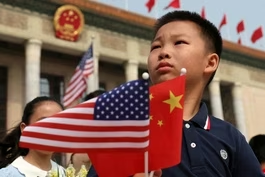
Analysts examine Trump-Xi call for stability and cooperation
Video has Closed Captions
Analysts break down Trump-Xi meeting and calls for stability and cooperation (8m 25s)
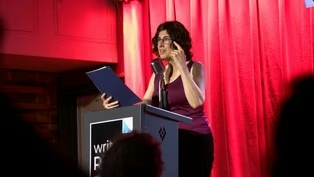
BLR celebrates 25 years of stories on illness and recovery
Video has Closed Captions
Bellevue Literary Review celebrates 25 years of stories on illness and recovery (7m 2s)
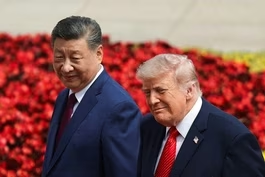
China offers Trump grand welcome, issues warning on Taiwan
Video has Closed Captions
China offers Trump grand welcome, but issues warning on Taiwan (7m 16s)
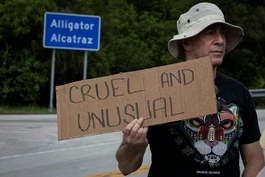
Florida's 'Alligator Alcatraz' expected to close
Video has Closed Captions
Florida's controversial 'Alligator Alcatraz' expected to close (5m 12s)

How reality TV stars seeking office are changing politics
Video has Closed Captions
How reality TV stars seeking office are changing politics (9m 21s)
News Wrap: Senate votes to withhold pay during shutdowns
Video has Closed Captions
News Wrap: Senate votes to withhold their own pay during future shutdowns (6m 16s)

Supreme Court extends access to mifepristone, for now
Video has Closed Captions
Supreme Court extends access to mifepristone, for now (3m 54s)
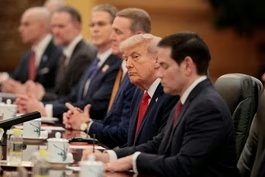
U.S.-China reset faces 'contradictions,' expert warns
Video has Closed Captions
U.S.-China diplomatic reset faces unresolved 'contradictions,' expert warns (3m 56s)
Providing Support for PBS.org
Learn Moreabout PBS online sponsorship
- News and Public Affairs

FRONTLINE is investigative journalism that questions, explains and changes our world.

- News and Public Affairs

Today's top journalists discuss Washington's current political events and public affairs.

 New Episode





 New Season
 New Episode
Support for PBS provided by:
Major corporate funding for the PBS News Hour is provided by BDO, BNSF, Consumer Cellular, American Cruise Lines, and Raymond James. Funding for the PBS NewsHour Weekend is provided by...