Inland Edition
The Cheech
Special | 26m 46sVideo has Closed Captions
Discover the vibrant world of The Cheech Marin Center for Chicano Art & Culture.
Discover the vibrant world of The Cheech Marin Center for Chicano Art & Culture, where Chicano art takes center stage, as we explore the importance of this remarkable collection. Host Joe Richardson sits down with the man himself, Cheech Marin, and the artistic director of The Cheech, Maria Fernandez, for this special edition of Inland Edition.
Problems playing video? | Closed Captioning Feedback
Problems playing video? | Closed Captioning Feedback
Inland Edition is a local public television program presented by KVCR
Inland Edition
The Cheech
Special | 26m 46sVideo has Closed Captions
Discover the vibrant world of The Cheech Marin Center for Chicano Art & Culture, where Chicano art takes center stage, as we explore the importance of this remarkable collection. Host Joe Richardson sits down with the man himself, Cheech Marin, and the artistic director of The Cheech, Maria Fernandez, for this special edition of Inland Edition.
Problems playing video? | Closed Captioning Feedback
How to Watch Inland Edition
Inland Edition is available to stream on pbs.org and the free PBS App, available on iPhone, Apple TV, Android TV, Android smartphones, Amazon Fire TV, Amazon Fire Tablet, Roku, Samsung Smart TV, and Vizio.
Providing Support for PBS.org
Learn Moreabout PBS online sponsorship- Telling an artist what to do and what to paint is the worst advice you could ever give, 'cause, you know, they have their own vision, and that's why they're an artist.
So, we wanna see how the artists react to changing currents that are out there right now, and that's important, because it's always-- One of the essential aspects of Chicano art is that it's news from the front.
This is what's happening today.
[low bass guitar tones] ♪ [percussive hip-hop beat] ♪ (whoosh!)
- So, when we say, "The Cheech," what do we actually mean?
- Wow.
We immediately think, obviously the art and the collection, which has been a very important collection in getting the word out on Chicano art.
Cheech started collecting original works of art when nobody was collecting these works.
- Right.
- I mean, there were some artists that were in the art world that were out there, but not to the extent that it is now, and I think Cheech's collection has a large part, you know, in getting that attention.
He could've just collected the work and kept it at home, but he went out there, and knocked on doors, and created 12 exhibitions out of his collection.
Which is really unprecedented for a collector to be so generous with their work in that way, and ensured that these artists received attention from mainstream institutions.
- Maybe some people have heard about "The Cheech," and we're here to talk about that.
- Uh huh.
- But, were you always an art guy?
- Yes!
Surprisingly, from a very early age.
- Right.
I had this group of cousins.
There was four of us, and we were bright kids that wanted to do more than the school was teaching.
So, we-- The head cousin, Louie, assigned us all topics to go and research and bring back to the group, and I got assigned art.
- Right.
- I was nine years old.
- Wow!
Look at that.
- And, you know, so that's-- How do you do that?
I went to the library and started looking through all the art books, and that's how I got my start.
- Wow.
So you, eventually, you become, you know, who we all know to be Cheech Marin.
When does-?
So, is art just a continuum, where-?
Once later on you had some resources, you started studying art, then you started buying art.
Talk about that evolution.
- Yeah.
Well?
I knew art, you know, Western art for the most part when I was 10, 11, right in there, and I was pretty comprehensive on that.
And so, I always had it in the back of my mind because I grew up Catholic.
And that was, you know, part of the church; the paintings on the ceilings, and guys walking around in sheets in the clouds, and some guy being tortured in the corner, you know?
(Joe laughs) Like, "Okay, I get it!"
(Joe laughs) And so, I started doing that, and then that always stayed with it.
But, the thing that they told me at the library, the librarians were helping me, and they said, "But, you have to go to museums."
- Right.
- Because you have to see paintings in person.
And, I always remembered that, so I continued that process throughout my life to this day.
- [Joe] How big is Cheech's collection?
- [Maria] So, the gift that Cheech gave to the Riverside Art Museum permanent collection is over 500 works.
He still has a personal collection that we borrow from, because it's important to keep the whole collection in conversation.
So, he's very generous in that way, that not only did he donate the gift, but he allows us to go in, and I ransack his house, (laughs) and take out all the new works, and bring 'em in, because it'll always be one intact collection.
[mellow guitar music] - [Joe] So, do you sometimes just kinda take laps here, and like, "Oh!
Well, let me just kind of contemplate how that looks," and, you know, that kind of thing?
- [Maria] Absolutely!
I take some time to sit just in the galleries when I need a break from being on the laptop or sitting at the desk.
- [Joe] Right!
- I get to have my steps here at the museum.
(Joe chuckles) So, I love to sit and contemplate with the art whenever I can.
- Yeah, yeah!
That would seem like that makes sense.
And this is a great place for you to get your steps, too!
- [Maria] Absolutely!
Absolutely!
(Joe and Maria laugh) - [Joe] So, is this part of the larger Riverside Art Museum?
- Yes, the Riverside Art Museum is an institution that was founded by artists.
They are a community-based museum that has been in existence over 60 years, and, not surprising, it's those midsize museums that work while working in community are just nimble in that way, and say, "You know what?
Let's dream big.
Let's open this space."
And, in 2017, they had the "Works on Paper: Papel Chicano Dos," Cheech's collection, and there were so many folks that came out.
There was a line out the door.
I wasn't here.
I heard the story.
And, city officials were just blown away.
And so, that's-- Here we were, five years later, opening this space from ideation to opening the doors.
(birds singing) - [Joe] So, now you get to go to your own museum!
- Isn't that cool?
(laughs) - How do you-?
Listen, listen!
- That is the coolest!
- How do you go from collecting art, buying art, appreciating art, to having your own art spot?
- God, it's just-?
It's such-- It came out of the blue.
It dropped out of the heavens!
I swear to God, you know?
'Cause all during the process of while I was collecting, that was almost 50 years, people say, "You should have your own museum."
- Right.
Sure.
- I should have a jet plane too, but I don't got one!
(Joe laughs) And so, you know, figure out how to do it.
But, this offer came in out of the blue.
The city came to me!
I didn't know what they were asking, at first.
You want me to buy a museum?
- Right.
Yeah.
- I'm doing okay.
I don't know if I'm museum rich here at this point!
(Joe laughs) You know?
But, no.
But, they explained to me what it was going to entail.
- [Joe] Right, sure.
- And, what it was, that I gave them the collection.
- Right.
- Gave it, not loaned it to 'em.
Not, you know-?
Have to give it to them, and they would-- It would be the only thing in the museum.
It would be a museum just for that collection.
- Wow.
What I understand is that people's art is very sacred.
- [Cheech] Oh, yeah.
- Right?
You know what I mean?
So, obviously there has to be, I surmise, a purpose-- - Yeah!
- that you see-- - Yeah.
- in what sharing your art - Yeah.
- is going to do for this community.
So, connect the dots for us in terms of, "Here's what I wanted the giving of my art to do."
- [Cheech] Yeah.
I wanted it to be-- When it was explained to me what exactly they wanted-- So, I realized that this could be the very first Chicano art museum.
- [Joe] Mm!
- The very first Chicano museum basically of any kind.
- [Joe] Wow.
- And, it had been a long time and that should have happened and never did, but there's a lot of categories that never had their museum that should've, you know?
I was lucky enough to be in the right place at the right time, you know?
And, I was struggling with it.
And, I was looking for a sign.
I'm like, being a Catholic, I was (both laughing) a believer in signs, and I was walking through this building when they were-- 'Cause it was a town library.
They were clearing it out; all the books, all the shelves.
And, I was walking with the proprietor of the building at the time, and I said, "This is a big building.
How big is this building?"
I was looking for a sign, you know?
And, she says, "Well, it's 66,420 square feet."
I went, "Four, four?
"420?
"420?!
That's the sign!
(both laugh) "Okay!
I'm gonna do this!"
- [Joe] Right!
Wow, wow.
- And it just worked out, you know?
And, it was such a thirst for it.
You know?
There really was a thirst.
And, this is the perfect place.
- [Joe] Right.
- Riverside is 52% Latino, you know, and as well as the Inland Empire.
So, if there was ever a reception-- a great reception place, it was going to be this one.
[light ambling music] - [Joe] So, what do we have here?
- [Cheech] These are pastels by Leo Limón.
He's a Los Angeles painter.
He's still around.
And, he just does fantastic, wonderful things with these paintings, and he does a lot with Aztec mythology.
- [Joe] Right.
- And, a lot of contemporary things.
But he has all these symbols, and he was a student of Carlos Almaraz, who was one of the original, original Chicano painters, who has since passed on, but he's-- We have some of his paintings here.
- [Joe] And, you told me earlier that a lot of these guys really work fast.
He'll surprise!
- Yeah!
You know, there's like-- You see a good painter paint, and they're just... (vocalizing painting) like fast, 'cause they know what they're doing, you know?
- 'Cause they know art!
Yeah.
- Yeah, and then it's not very precious about it, you know?
- Right.
- [Cheech] And, here's a nice Carlos Almaraz.
He was famous for his car-- - [Joe] That's the one that trained other guy?
- Yeah, exactly!
- OK.
Gotcha.
See?
I was listening!
- Yeah, I know!
- Hey, I'm here!
- That's very good.
This is a test!
(both laughing) But, he came to prominence a bit by these series of car crash paintings.
- Mm hm.
- [Cheech] You know, and this is a pastel version of it, but he has-- I'll show you some other ones over here.
But, he was the one that started the whole Chicano movement here in LA.
- [Joe] Oh, wow.
- And, there was nobody better than him.
- [Joe] I understand that being artistic director encompasses many things, including being the curator.
So, talk about that, because usually in my little simple thing, "Oh!
You know, museum?
Curator?
Boom."
But, apparently there's an artistic director that curates, among other things.
So, tell us about that.
- [Maria] Well, curation is my passion.
It's being a caretaker of stories.
I've had the privilege of working with living artists, but it includes community programming.
We have a wonderful staff that programs on our free days.
And, it's engaging in those conversations with our community partners, with our staff here, of how we wanna program, how is it that we wanna welcome folks into our space here.
So, it's been a privilege.
I have been so moved interacting with families who are here, who never thought they would see a space like this dedicated to our stories.
- Wow.
So, talk about how The Cheech splits up, 'cause I know there's sections here.
- [Maria] Immediately when you walk in, you have the Altura Credit Union Community Gallery, which features artists of all levels, so not just professional artists, but creatives, folks that maybe wouldn't even call themselves artists.
And, it's an integral part of the curatorial department because it's a way of opening up these, I would say, historically unreachable departments.
So, we have brought, I feel, a lot of attention to our local artists.
Of course, the downstairs features the permanent collection exhibition, which is the draw for people when they come to see Cheech's collection.
And, upstairs we have rotating exhibitions, works on loan, as well as exhibitions that we organize in house.
[jazzy guitar music] ♪ - [Joe] So, we've got some interesting paintings along here.
Tell us about, even as you get into the different paintings, tell us about the unifying thing with these paintings here.
- Absolutely.
This is our-- one of our Texas sections here.
The focus here was to show the range of what we have in terms of what the artists are reflecting.
And so, you'll see urbanscape.
You'll see portraiture.
You'll see something a little bit more surreal here with this Adán Hernández painting, to this hyperrealistic portrait coming up by Gaspar Enriquez here.
We are very excited to feature just a range and depth of the collection that what we have from Texas.
- [Joe] Right.
Amazing, amazing.
Is it from all parts of Texas, or certain parts of Texas?
- We have artists from San Antonio, from Corpus Christi, El Paso, Houston.
So, we have quite a bit of the cities reflected here.
And, this is an artist not from Texas; Los Angeles, Frank Romero.
He is featuring "Teatro Campesino", which was a theater troupe that started from the strikes, the farmworker strikes that were happening in the 1960s.
[bright jazzy horn music] ♪ - [Joe] Now, how often do things rotate?
- Typically, the exhibition is up for a year, and it'll feature some of the iconic works from his important "Chicano Visions" exhibition that folks expect to see when they arrive.
And then, it features some never-before-seen works every iteration.
We're still taking out works that are new that folks haven't seen.
- [Joe] Wow.
- As well as donations and acquisitions that the Riverside Art Museum has made for The Cheech.
- Okay.
So, there's some donations that come separately from Cheech to Cheech.
It comes to The Cheech, but some-- they have some things from the Riverside Art Museum itself.
- Absolutely.
It's important for us not only to feature Cheech's important collection, but to think of the work as-- of the center, as building a legacy, complicating what people think about when they think about Chicano art.
There's-- If they even think about Chicano art.
And so, I think it's important for folks when they come here to see a lot of different kinds of work, and to hopefully see a rich dialogue that complicates what they think about.
- So, I wanna build on that a little bit, because it would seem to me that you would be very intentional.
Art's always an opportunity anyway, right, to say some things, to point some things out, to be a sign of the times.
Tell me about the intention that as curator, as curator, that you really execute in terms of what gets set up here.
- It's important to show the depth of the collection, which means featuring different medium, making sure that we have a different medium reflected in every iteration.
So, not only the paintings, the big bold paintings and narrative works, but also sculpture, and new acquisitions in photography.
It's important for us to, like you mentioned, reflect what artists are thinking about.
And, there's works that we've also left here on view over the last three years, like "Arrest of the Paleteros" by Frank Romero, who, you know, is talking about the criminalization of street vendors.
It's something that's happened before, that's happening now.
And, it's important for us to reflect the intention of the artist in depicting those histories and those stories.
- [Joe] I imagine that you probably have art and look at art that is a sign of the times.
- Yeah!
- Kind of what's going on now, and that type of thing.
Talk about that a little bit in terms of how that's evolved over time.
There's always somethin' goin' on, right?
You know?
- Yes.
Always.
- You see it in music, you see it in art.
You know what I mean?
- Yes, exactly.
- And, talk about that some.
- [Cheech] The Chicano movement, the art movement started as the visual component of the Chicano civil rights movement.
So, it was political in the sense that they were the sign makers and the placard makers.
- Right.
- And so, eventually they evolved into their own artistic pursuits, you know?
And that's where it kept starting evolving, evolving.
But, it-- Every new generation that comes into the vein of artists brings "news from the front," I call it.
You know?
- Sure, yeah.
- "This is what's happening in my neighborhood.
These are the people in my neighborhood."
- Sure.
- "This is what their "concerns are.
You know, the most intimate and the most public."
You know?
So-- - [Joe] Right, right.
♪ [light upbeat percussive music] ♪ - [Joe] So, let's talk about some of these paintings.
I know there's-- All of 'em have a story behind them, but give us some of the ones that stick out for you as we go along here.
- This one is by John Valadez, who is one of the OG Chicano painters in LA.
- Right.
- This is actually a pastel.
- [Joe] Right.
Oh, wow!
- You know, which is opposite from the way pastels are usually used.
You know, there are flowers and trees.
- Right.
- And, you know, something ethereal.
But it's photorealistic with-- 'Cause it's a blunt instrument, you know?
- Right, right!
- It has a rounded head, and to get this all in, then.
And, it's just the results of a drive-by shooting or a gang-related thing.
But it's a beautiful surrealistic, but a spiritual painting at the same time.
And, this is Margaret Garcia, who is one of my favorites!
- [Joe] Okay.
- And, these are...uh?
Actually these are watercolors, a wash.
- Oh, wow.
- A real thick wash.
Another one by Adán Hernandez.
- Oh, wow.
- [Cheech] And, this is cool!
You know, he's the dark side.
He was Chicano noir, you know?
- [Joe] Sure.
That's the first thing I thought.
I see the hat and everything.
- Yeah!
And it's at night, and...(pichoo!)
There's gunshots going off.
But, right behind, right here?
- Okay!
- Is a wonderful painting.
- Oh, my gosh!
That's amazing.
- [Cheech] Once again, it's a pastel!
- Right.
Wow.
- This is a pastel.
- Yeah.
It's not what you'd think, huh?
- Yeah.
I had Steve Martin over the house one time, and I've known him for a long time.
And he's an art collector too, has a big collection.
And so, he's going through the house, and he stopped in front of this painting, and he says, "How come you have a glass on this painting?"
I said, "Because it's a pastel."
And, he went, "What?!
That's a pastel?"
- [Joe] Right!
- [Cheech] I mean, this is Vincent's grandfather who taught him how to paint, and he was a painter then.
- Wow!
- [Cheech] Vincent is enjoying a moment now, and he just was Texas Artist of the Year last year.
And, this over here, if you can sweep around, this is Carlos Almaraz-- - Okay, okay!
Yeah.
- who I just said.
And, this is maybe the most famous of his car crash paintings.
- [Joe] So, he's got a whole series of those!
That's what you were saying?
Okay.
- Yeah.
Yeah.
- Wow.
- I don't-?
Maybe there's seven, eight of these kind of paintings, but they're, you know, they're very precious.
And... But then, it comes into the Fire Room, and it's very prominent now because of the fires in LA, which I was in, on the Palisades.
And, it makes people come.
That's why you put a bench in here.
- [Joe] Right.
Yeah.
- [Cheech] So, people can sit and ponder them.
Which they do, man.
'Cause it affected them, you know?
- [Joe] So, I'm sure that as you're walking around here, you get ideas about the future.
You know, you see the evolution; you know what it was, you know what it is.
What does it make you think about what it'll be?
And then, the future of The Cheech as you're walking up and down the hallway and looking at what you have?
- Well, you think you know, but you don't know!
- Right, sure!
- I mean, I have things that I think is gonna happen, and it always turns out exactly the opposite from it.
(Joe laughs) Because you can't control art, and, especially, you can't control artists.
Telling an artist what to do and what to paint is the worst advice you could ever give, (chuckles) 'cause, you know, they have their own vision.
- Sure.
- And, that's why they're an artist.
So, we wanna see how the artists react to changing currents- - Right.
- that are out there right now.
And that's important, because it's always-- One of the essential aspects of Chicano art is that it's "news from the front."
- Mm!
- This is what's happening today.
They got a lot of big canvases out there that need filling right now that explain what their feelings are.
We're in our fourth generation of Chicano painters right now.
- Wow.
- [Cheech] So, it goes by fast.
And, everybody has their own spokesman, or their own voices for that particular period.
And, I wanna see them emerge.
I mean, that's the greatest thing about collecting.
- Yeah.
- The new people that come in.
- [Joe] Yeah.
So, you can be excited and embrace the fact that I have no idea where this is gonna go, and I'm excited about it because it's going to be from the front, right?
- [Cheech] Yeah.
And, we know these guys.
We know what they're capable of doing, you know?
So, it's a great process.
- Right, right.
- Because I just have no greater joy than standing in front of a new painting by a new artist I've never seen, going, "Wow, that's cool!"
You know?
(they laugh) But, that "cool" is informed by a lot of years of looking at art, you know?
- Yeah.
- And, we stand in with the rest of the guys, you know?
So-- - [Joe] Wow!
That's amazing.
It's just amazing that nothing like this has happened to this point, and it's amazing how it was able to come together, with Cheech being a very known figure that could draw attention to it by virtue of who he is.
But, talk about the gap and the need that this place, that The Cheech actually fills in the context of the larger art world that just wasn't-- that just wasn't filled before.
- [Maria] We stand on the shoulders of arts organizations, Chicano arts organizations that came out of the movement.
And, I'm thinking of places like, you know, Self Help Graphics, La Galería de la Raza, in San Francisco.
There's a lot of organizations, Chicano organizations that did-- that do, and continue to do that work.
What I was blown away by is that we have now a space that through Cheech's celebrity, through his hard work of over 40 years of collecting, we're able now to leverage that attention in service of the artists.
And, that's where the space of hope and possibility exists in bridging that gap that you're talking about, this gap that exists.
So, you have sociologists, you have political scientists that are looking at this work, and that marriage of all of these different disciplines and lenses at which to look this work-- look at this work is what's exciting.
And, that we can do that here, and not only celebrate their conceptual and aesthetic contributions, but also that they have preserved these stories and histories that need to be told.
- [Joe] So, theoretically, you're a "baby museum!"
- [Cheech] Yeah!
- [Joe] But-?
I don't know.
Between the Cheech name, and the fact that this really fills a gap.
- Yeah.
- That's not here, which-- It's incredulous that this would be, like, a first- - Yeah.
- where we are, given the Chicano contributions to society, to America, to...I mean-?
It's nuts, actually!
- Yeah.
- But, maybe, I'd like to think, and maybe you'd agree, that you're the fact that you fill a need; the way that you do, the fact that you are way-- You know, you're ahead of your time as well as coming from behind.
- Yeah.
- Overdue!
- Uh huh.
- Maybe that helps with, and helps facilitate not only the attention that you get and then the related survival.
- [Cheech] Yeah.
Well?
You know, all those factors are definitely in play.
The other thing that's in play that nobody else has is celebrity.
- Yeah!
- You know?
And, if it wasn't for celebrity, I would just be a guy with a collection.
- True.
- You know?
But now, museum directors in other cities?
"Oh!
People are gonna come."
- [Joe] Right.
Sure.
- They know that name, and they associate it now with art, as well as the past.
They're gonna come, and they're gonna have attendance, which all museums need: attendance!
- Right.
Sure.
- And so, that really facilitated that.
So, I used that celebrity in order to open a zillion doors, and that's what's happened.
- Right.
What would you want people to say about Cheech Marin as it pertains to art?
- Ahh?
Ooh!
"Too bad he wasn't a painter.
He probably could've done well!"
(both laughing) I was an artist, you know?
- Yeah?
- I was a potter, a professional potter for years.
- Yeah, you studied ceramics.
You did ceramics.
- Yeah, exactly.
In college, my last semester.
My last semester, I took a pottery class just to kind of have something to do.
- Right, right!
- And, I fell in love with pottery.
And, my Mexican genes came jumping out!
(laughter) "Come on, dude!
We got some cups to make here!"
You know?
And so, that was-- I mean, I knew I was an artist.
I always knew I was an artist of some kind.
- Right.
- I didn't have a medium.
I was a singer always from a very early age, and I was always involved in music.
But art is, you know, you paint, or you draw, or so.
And, when I discovered pottery?
Like, that's it!
I quit all my classes, quit my job; just did pottery.
- Wow!
And then, I moved to Canada to be an assistant to a very famous potter: Ed Drahanchuk there in Calgary.
And so, that was it.
You know?
- Wow.
- But, at some point, the music crept back in.
- Sure.
You know?
And, I used to just kind of-- When I met Tommy Chong in Vancouver, and he was running this improvisational theater company in a topless bar, I said, "Well, yeah!
That's for me!"
(both laughing) - [Joe] "I'll get back to this art when I can!"
Unbelievable.
- [Cheech] Yeah.
You know, I just-- I believe in sharpening your instinct.
- Sure.
- And, you sharpen your instinct by either seeing 10,000 paintings or doing some act 10,000 times, so you know what you're talking about.
So, when you see something new, you recognize it right away, and that's your instinct.
And, you have to trust your instinct.
- Right.
- Hard thing to do.
- [Joe] Yeah.
Wow.
You can't have "The Cheech" without Cheech!
- The Cheech!
- The Cheech-!
- The Cheech!
Marin!
Cheech Marin, thank you so much for being on "Inland Edition"- - Thank you very much.
- making this a special edition of "Inland Edition."
- Thank you very much.
- Thank you, sir.
- My pleasure.
South Central!
- Yeah!
South Central, all day long!
- [Cheech] All day long!
(chuckles) ♪ [cheerful jazzy piano music] ♪ ♪ [cheerful jazzy piano music] ♪ ♪ ♪
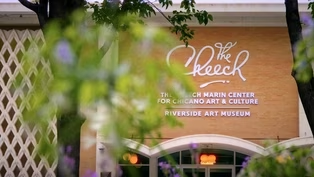
Discover the vibrant world of The Cheech Marin Center for Chicano Art & Culture. (30s)
Providing Support for PBS.org
Learn Moreabout PBS online sponsorship
- News and Public Affairs

Top journalists deliver compelling original analysis of the hour's headlines.

- News and Public Affairs

FRONTLINE is investigative journalism that questions, explains and changes our world.












Support for PBS provided by:
Inland Edition is a local public television program presented by KVCR